

News
Government signs 150 MW solar agreement targeting MVR 1.2bn in annual savings
The Environment Ministry, STELCO and China's Guosheng Energy have signed a framework agreement to develop 150 MW of hybrid solar power systems. Once implemented, the project is expected to save MVR 1.2 billion annually and reduce carbon emissions by nearly 200,000 tonnes.
26 November 2026, 07:01
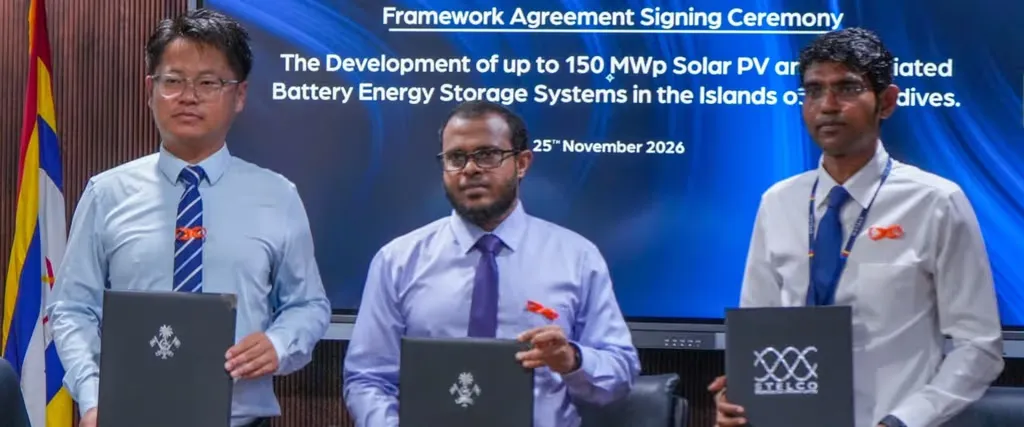
The Ministry of Climate Change, Environment and Energy has signed a framework agreement with State Electric Company Limited (STELCO) and China's Guosheng Energy Company Limited to develop 150 megawatts (MW) of hybrid solar power systems across the Maldives.
The agreement, signed on 25 November 2026 at STELCO Hall, covers the proposed development of solar photovoltaic systems integrated with battery energy storage and electricity grids under a Power Purchase Agreement (PPA) model.
According to the Ministry, the project is expected to generate annual savings of approximately MVR 1.2 billion through reduced fuel expenditure for electricity generation and lower government spending on electricity subsidies.
The proposed systems are also projected to reduce carbon dioxide emissions by approximately 198,283 tonnes annually.
The agreement was signed by Minister of Climate Change, Environment and Energy Ali Shareef and STELCO Managing Director Dr Ali Azwar on behalf of their respective institutions.
The project forms part of the Government's broader renewable energy strategy, which aims to generate 33% of the country's electricity from renewable sources by the end of 2028.
The target was announced by President Dr Mohamed Muizzu at the United Nations Climate Change Conference (COP28) in 2023.
The Ministry estimates that the successful implementation of the 150 MW project would fulfil approximately 60% of the Government's renewable energy target.
The Maldives remains heavily dependent on imported fuel for electricity generation, with the Ministry estimating that fuel expenditure accounts for up to 10% of the country's gross domestic product.
Expanding renewable energy generation is intended to reduce this dependence while easing pressure on public finances and lowering electricity production costs.
Speaking at the signing ceremony, Minister Ali Shareef described the project as the largest initiative undertaken under the Government's renewable energy policy and expressed hope that implementation would begin in 2027.
The framework agreement represents a step towards developing the proposed systems, with the projected financial and environmental benefits dependent on successful implementation.
Leave a comment
Comments
No comments yet. Be the first to comment!
Latest News
News
MACL clarifies viral airport videos were part of security exercise
26 Nov 2026
MMA
MMA doubles security deposits for money changers under new regulation
26 Nov 2026
Opinion
A Capital Market That Cannot Deliver: Why the Maldives Cannot Afford More Delay
25 Nov 2026
News
Vara Expo 2026 targets over 500 youth jobs with more than 150 exhibitors
25 Nov 2026