

Opinion
Permits, pay and geography: why Maldivian scientists are missing from their own marine research
Parachute science explains the overrepresentation of foreigners in the scientific literature about our sea. It does not explain why our own reef programme — the oldest we have — has published the least.
Nizam Ibrahim
12 August 2026, 06:28
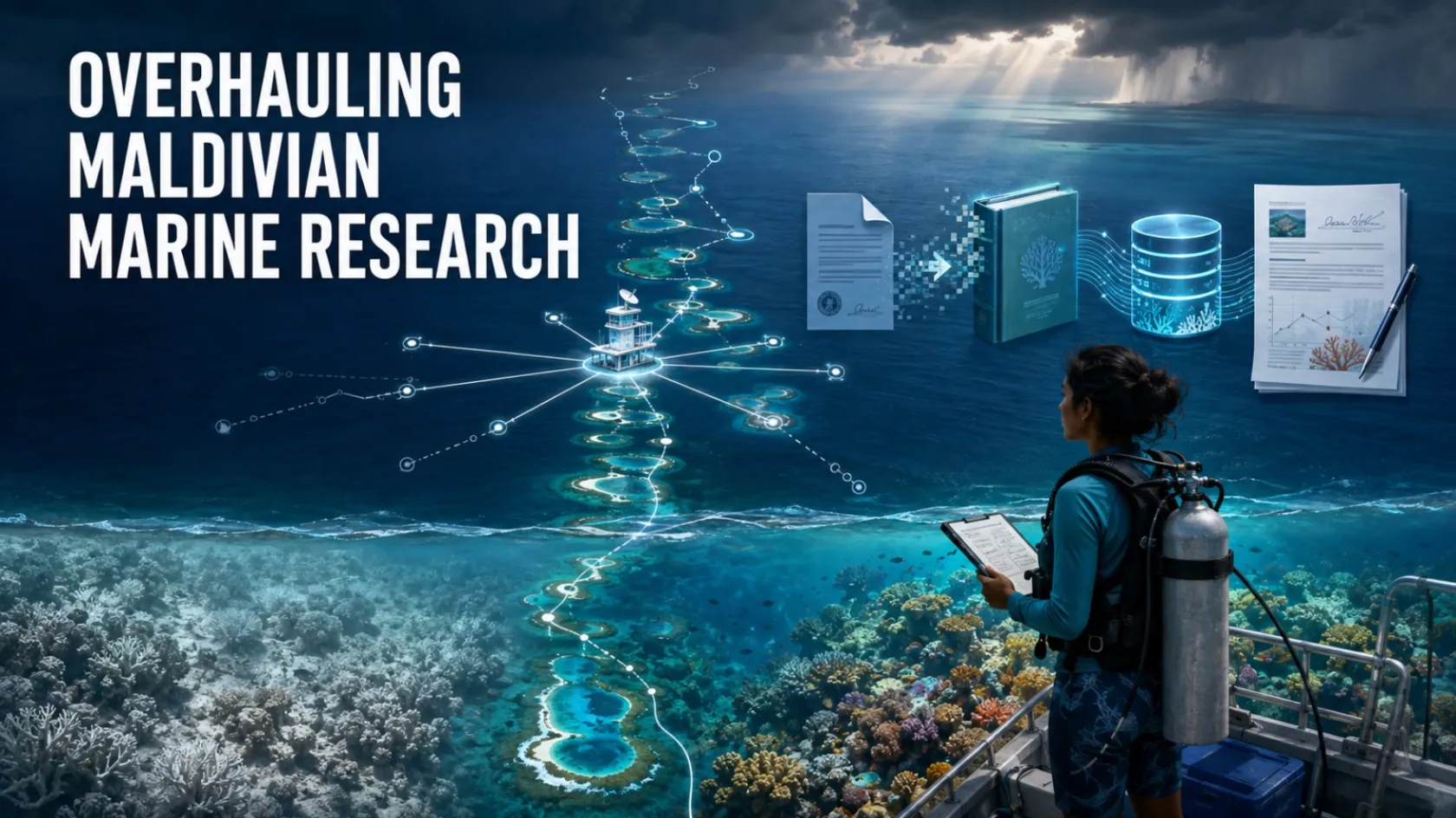
The study Hana Amir and Aishath Sara Hashim presented at the Sixth Maldives Marine Science Symposium is the most useful thing to happen to this debate in twenty years. Screening 6,425 records down to 460 peer-reviewed articles on Maldivian marine science published between 1985 and 2025, they found that fewer than 40% carried any Maldivian affiliation and that just 34 papers, 7.4%, had a Maldivian first author. Fifty-two discovery studies had no Maldivian author.
Those are the facts. The interpretation is where I want to push back.
Most readers will take this as a story about foreign researchers. It partly is. But a seven per cent first-authorship rate is not primarily an indictment of visiting scientists. It measures our own research system: what it was funded to do, where it could go, who it employed, how long it kept them, and what it counted as a finished product. Foreign researchers did not decide that the National Coral Reef Monitoring Programme would run for a quarter of a century without producing a sustained peer-reviewed record. We did.
I worked inside the National Marine Research Institute from 2015 to 2021. What follows is visible in the published record, and anyone can check it.
Parachute science is real. It also has a ceiling.
The international diagnosis is well established. Stefanoudis and colleagues showed in Current Biology in 2021 that coral reef research is dominated by high-income countries; Ahmadia and colleagues found that across 1,677 coral reef papers published between 2003 and 2018, OECD authors held 89 per cent of authorship contributions, including 68 per cent of contributions to work carried out in non-OECD countries.
The Maldives fits the pattern. The Milano-Bicocca outpost at Magoodhoo has operated for sixteen years, with more than a hundred affiliated papers, five of which have a Maldivian co-author, and its researchers have conceded that local collaboration has not been a focus.
But the parachute literature explains only why foreigners are over-represented. It cannot explain why Maldivian output is distributed so unevenly across our research domains. Of the 34 Maldivian-first-authored papers, thirteen were about fisheries; six were about coral reefs. That skew was not produced in Milan or Oxford. It was produced by our budget lines.
Where Maldivian research output comes from
Tuna is the one programme built like a programme. The lineage runs unbroken from the Marine Research Section of the 1980s to today: Anderson, Hafiz and Adam's 176-page review of the fishery in 1996; Miller, Nadheeh, Jauharee, Anderson and Adam on pole-and-line bycatch in PLOS ONE in 2017; the Medley–Ahusan–Adam catch-rate series still running.
Why this domain and not others? Three structural reasons, none about talent. As an IOTC member, the Maldives must file a national report every year and defend its numbers before a regional scientific body, which turns data collection into an annually authored product. MSC certification of the pole-and-line fishery in 2012 came with conditions that only research could close, making science a cost of market access. And IPNLF was a permanent partner with a commercial reason to put Maldivian names on papers.
A recurring obligation, an external accountability forum, and a partner who needs your name on the paper. Every one of the three is absent from coral reef research.
Grouper and reef fisheries get funded when an export line is threatened — Adam and Sattar's 2005 review, the Darwin Reef Fish Project, the 2020 Grouper Fishery Management Plan, the work that put minimum landing sizes into law in 2021 on the finding that 70 to 90% of groupers landed are immature. Real, substantially Maldivian-authored, and almost entirely grey literature, invisible to the kind of database search Amir and Hashim ran. Mariculture shows the mismatch most starkly: the IFAD-supported project from 2013, pearl culture, grouper and sea cucumber trials at Maniyafushi, years of staff time, a field station, donor money at scale, and an almost undetectable peer-reviewed footprint. Those outputs were deliverable for a project cycle, not citable knowledge.
Coral reefs are the oldest and the weakest. Consistent monitoring began in 1989 with ICOD support. After the 1998 bleaching killed 60 to 100% of shallow-water coral at monitored sites, the National Coral Reef Monitoring Programme was set up with fifteen long-term sites across the north, center, and south; a national framework; a database; and a coral-cover series running from 1998 to 2021.
And yet the peer-reviewed record of Maldivian reef ecology over that period is largely authored by foreigners. The most damning line about the program was written not by a critic but by its own partners: the 2017 MRC, IUCN, and USAID REGENERATE status report records that the NCRMP was designed to monitor its long-term sites annually, but that lack of capacity and financial limitations prevented that goal from being met.
That is the failure. Not the mandate, the framework, or the protocols all exist. The country's oldest environmental monitoring program could not reliably execute its own sampling design and could not convert twenty-five years of fieldwork into an authored record.
Why: three internal reasons nobody writes down
The last mile. The missing papers were not all unwritten. Much of the work was done; what failed was the conversion of finished fieldwork into a submitted manuscript. Publishing is a supervised craft, learned by having a senior author mark up a draft, argue about framing, and stay with it through review. Studies of publication barriers outside wealthy research systems repeatedly highlight that inadequate mentorship, supervision, and writing support rank ahead of funding for the science itself.
We had none of that structure. Senior scientists' jobs did not include bringing junior staff's manuscripts to publication; there was no internal review with a defined turnaround; a draft submitted had no route back. Where scrutiny does not develop a manuscript, it simply rejects one. Draft after draft was measured against an unwritten standard of completeness, found wanting, and shelved; no revision cycle, no allocation of who fixes what by when. Perfectionism is easy to mistake for rigor. Rigour produces a revised manuscript; perfectionism produces a binned one. A decade of that leaves a filing cabinet of sound reports that are too flawed to release and too minor to fix, which is why an outsider can say, with partial justification, that local science is not being published.
Favoritism. When a program is designated a priority, the effects do not stop at the budget line. The prioritized team gets the boat, the overseas training, the conference slot, the co-authorship, and the commendation. Staff on the deprioritized programs, reef monitoring above all, do comparable work and watch recognition flow along a channel they were never in. The organizational research is unambiguous: perceived fairness in how resources and recognition are shared out is among the strongest predictors of whether people leave and of the discretionary effort long-term monitoring runs on entirely.
Pay. Hana Amir's observation that Maldivians cannot stay in the field because the jobs do not pay enough to support a family is the most important sentence in the original article. Until recently, a government research post was among the worst-paid graduate careers in the country. Pay harmonisation arrived in phases: education from May 2022, health from May 2023, and the remaining civil servants and council staff from November 2025. Researchers spent most of a decade near the back of a queue, sequenced by political visibility. Many potential “budding scientists” left simply because the pay is not enough to make a living.
The consequence is arithmetic, not attitude. A monitoring time series needs a decade of the same person's attention; only a pay structure that retains that person for a decade can produce one, however good the framework document is. And note what this means to the parachute debate: an institution that cannot retain a mid-career scientist has no one available to be a meaningful co-investigator. The complaint about the lack of local publishers is, in part, a description of a hole we dug.
The permit system: the mechanism nobody regulated
Under Part XIII of the Law of the Sea Convention, consent to research in a coastal state's waters is not a bare yes or no. Article 249 grants the state the right to participate in the project, receive preliminary reports and final results, and access data and samples; Article 248 requires researchers to specify in advance how the state can participate. These are the instruments through which a small state builds scientific capacity if it uses them.
What does our process look like? A research application form dating from 2013; a separate protected-species permit for turtles, whale sharks, rays, and seabirds; and, since 2022, an online permit portal—built under the USAID-funded REGENERATE project and announced with the stated expectation that it would increase the number of research projects conducted in the country.
Read that again. Our principal reform of research access in a decade was framed as a volume measure. On the public face of the process, there is no requirement that an application name a Maldivian co-investigator with a substantive role; no mandatory deposit of data and specimens in a national repository; no obligation to send the resulting publication back to the state; no consequence at renewal for an institution that has taken twenty permits and produced no Maldivian co-authors; and no public register allowing anyone to check.
That is the mechanism. Foreign researchers are not slipping past our system; they are using it exactly as designed. The permit is treated as an administrative clearance, a customs formality for science, rather than the one point of leverage a small state hold.
We know conditions work because we have imposed them twice. In tuna, IOTC obligations and MSC requirements gave us a forum and a lever. In the 2022 Nekton mission, data and samples were vested with the Maldives by prior agreement, a taxonomic workshop was co-hosted with MMRI, and Maldivian scientists retained the right to name new species. Both worked because they were written down before the fieldwork started. Neither is a general rule. They should be.
The country is too big to research from one city
The archipelago runs roughly 900 kilometers north to south. Naseer and Hatcher's inventory, a Maldivian-led paper produced through a doctoral program abroad, counts 2,041 distinct reefs covering about 4,494 square kilometers, close to 5% of the world's reefs and, by area, the seventh-largest reef system on the planet. In reef terms, the Maldives is a large country. It is administered as a small one.
A team based in Malé does not make a field trip when reaching the deep south or far north; instead, it mo an expedition with charters or flights, freight for compressors and tanks, accommodation, per diems, and a fortnight of staff time. Cost per site rises steeply with distance from the capital, and the number of sites reachable in a year falls just as steeply. Facing a fixed budget, a centralized program rationally solves this by sampling near the center. The map in the Amir and Hashim study, dense in the central atolls, thin at both extremes, with Raa and Meemu showing no local representation at all, is the output of that arithmetic.
Huvadhu is the clearest casualty. It is the second-largest atoll in the country and among the ten largest in the world: roughly 3,152 sqkm, 255 islands (Guinness world record holder), an outer rim of some forty reef segments cut by deep channels, and administrative capitals 340 to 380 km from Malé. By any biological criterion, it should be a priority. It is instead among the least studied atolls in the country, not because the need is lower, but because it is too large and too far to survey annually from the capital on a central budget. When the consequences of the 2024 bleaching were assessed across the central atolls and Huvadhoo, the survey and the paper were foreign-led. On one recent occasion when Huvadhu was prominent in the literature, it appeared as someone else's study site.
Two permanent regional stations, a southern arm in Huvadhu, a northern arm in the Boduthiladhunmathi, each with a small vessel, compressor, wet lab, and two or three staff, would turn every survey in those regions from an expedition into a day trip for less than the recurrent cost of mounting southern expeditions from Malé.
And there is a proven model for the rest. Australia faces the same problem on a larger scale and solves it collectively. The core series is the Australian Institute of Marine Science's Long-Term Monitoring Program, now 40 years old, surveying 80 to 130 reefs a year and providing public data and an annual public report. Above it, the Reef 2050 Integrated Monitoring and Reporting Program brings twelve separate programmes, agencies, universities, tourism operators, community observers and Traditional Owners, into one framework governed by a written collaboration agreement. Nobody monitors the whole system alone; contributions from operators and communities are treated as data rather than outreach, and it holds together through an agreed protocol and a signed agreement rather than one institution's field capacity.
The Maldives owns every component and has never assembled them. MMRI holds the mandate and the protocol; the environment regulator monitors separately; MNU trains the graduates. Well over a hundred resort marine biology teams are stationed across the atolls, diving the same house reefs every week, the largest underused scientific workforce in the country. Dive operators and the Reef Check network hold nineteen years of central-atoll data that has already proved publishable. Councils hold the local mandate and the boats.
If the agreement specifies from the outset that contributed data enters a national dataset whose annual analysis is led and first authored domestically, every resort survey and council field day becomes a brick in a Maldivian-authored record rather than raw material for someone else's paper.
The clock
All of this would be worth doing in a calm decade. This is not one.
Maldivian reefs are entering another bleaching threat already weakened. The 2024 marine heatwave pushed sea temperatures to around 31.5°C, killing more than 40 per cent of live coral cover on average across surveyed central atoll reefs, with one Ari Atoll lagoon reef losing 57 per cent. NOAA has now declared Super El Niño conditions, with a high risk of global bleaching forecast from August through November 2026 and expected to persist into early 2027.
The article warns that monitoring only pays off if it is in place before, during and after a bleaching event, not after the fact. In 2024, it notes, the most complete assessment of Maldivian reefs came from a foreign research team. Unless the country's monitoring system is properly staffed and funded before this next event peaks, the piece argues, the Maldives risks again being studied by outsiders rather than documenting the crisis in its own waters.
What an overhaul would contain
Rewrite the research permit as a benefit-sharing instrument. Standard published conditions: a named Maldivian co-investigator with a defined role; deposit of data and specimens with the national institute; submission of the resulting manuscript and a Dhivehi summary; a capacity component proportionate to project size; and a public register of permits, with compliance history considered at renewal. The Nekton arrangements serve as the template and already exist in Maldivian practice.
Ring-fence core funding for long-term monitoring, separate from project money. A protected line item; at least two trained staff per programme, so no time series is one resignation from ending; and analysis and publication time written into job descriptions rather than treated as an after-hours virtue.
Establish two regional MMRI stations, north and south, and build a monitoring partnership around them, one protocol, one national database, a contributor tier for resort teams, NGOs, dive operators, and councils, a written agreement covering data ownership and authorship, and one annual national reef report with named Maldivian authors.
Give the institute a publication function, not just a research function. A named publication lead, a designated first author, and submission deadline for every completed survey; internal review with a fixed turnaround ending in a written revision assignment rather than an open verdict; and a revived, DOI-issuing national research series, the Maldives Marine Research Bulletin already existed, so grey literature becomes findable. The binned draft is not a quality-control success. It is the failure that this whole debate is measuring.
Fix the money and publish how it is allocated. Research grades that make a decade-long career viable; a central fund for article processing charges, which, at US$2,000 or more per paper, is a genuine barrier; and published rules for how field budgets, training places, and collaboration opportunities are shared between programmes.
Count it. Maldivian first authorship, permit compliance, and data-deposit rates belong in the fisheries and environment Strategic Action Plan as reported indicators. What is measured gets managed. This conversation is happening only because two researchers finally counted something.
The honest conclusion
There is a version of this argument that blames visitors and lets our institutions off the hook, and a version that blames ourselves and lets visitors off. Both are wrong.
Parachute science is real, and we are one of its clearer case studies. But foreign researchers exploited an opening; they did not create it. It was made by a research system that funded what an export market or a treaty obligation demanded and left the rest to attrition; that concentrated all national capability in one city while claiming a mandate over 2,041 reefs across 900 kilometres of ocean; that could not pay a reef ecologist enough to stay a decade, and rewarded unevenly those who did; that binned finished drafts against a standard it never resourced anyone to meet; and that issued research permits as though they were visas rather than contracts.
Fix the permits, ring-fence the monitoring, pay and treat researchers fairly, give the institute a publication function, and put two real stations in the north and the south with a partnership built around them, and the seven per cent moves without anyone having to be shamed into it. Leave those things alone, and the next bleaching event will be documented by somebody else, in a journal we cannot read, about a reef we live on. In 2040, someone will run the same search, find the same result, and write the same article.
Editor's Note: This article was written by Nizam Ibrahim, who worked as a senior research officer at the Maldives Marine Research Institute from 2015 to 2021. He holds a master's degree in marine science and management from Southern Cross University, where he is currently a PhD candidate in coral reef restoration. The views expressed are the author's own.
Leave a comment
Comments
No comments yet. Be the first to comment!
Latest News
News
Maldivian seeks up to two Airbus A220-300 aircraft for international routes
11 Oct 2026
MMA
MMA Governor Shares Maldives’ Experience in Reserve Management at Regional Forum
11 Oct 2026
News
Maldives Finance Forum 2026 set for 14 November with focus on green finance
11 Oct 2026
Opinion
Moody’s upgrade highlights the role of foreign exchange reforms and debt management
10 Oct 2026