

Features
Numbers Don't Lie: Maldives Tourism's Worst Quarter Since the Pandemic
The Ministry of Tourism and Civil Aviation publishes its arrival statistics every day. For most of the past decade, those numbers were a source of national pride. In 2026, they have become a damage report.
26 May 2026, 19:07

A Year That Started Strong — Then Broke
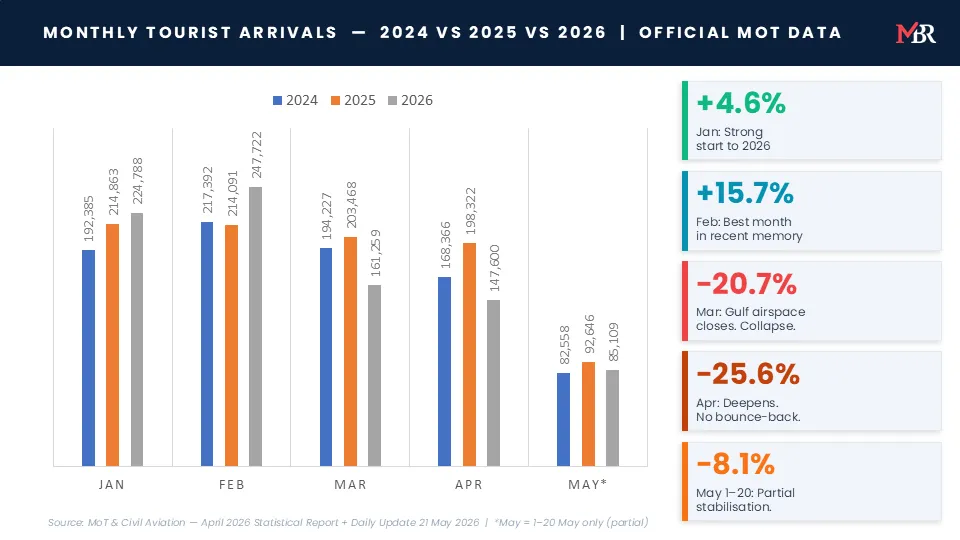
January 2026 opened with a 5.0 percent increase in tourist arrivals over 2025. February delivered the strongest monthly performance in recent memory: 254,556 tourists — up 15.7 percent year-on-year. The government's target of 2.5 million visitors for the full year seemed achievable.
Then came February 28.
Joint US and Israeli strikes on Iranian targets shut down aviation across the Gulf. Dubai International, Hamad International in Doha, and Abu Dhabi's Zayed International — the three transit megahubs through which the majority of European travelers connect to Malé — either closed or sharply curtailed operations.
The Maldives had recorded its best February in years. Within days, it was in crisis.
The Data: A Deepening Collapse
The official figures from the Ministry of Tourism and Civil Aviation leave little room for ambiguity.
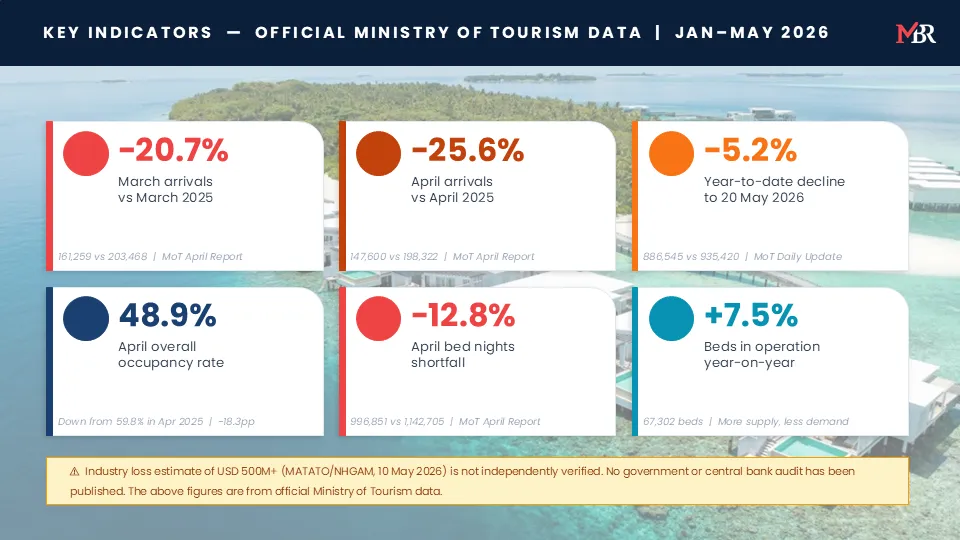
March 2026 tourist arrivals: 161,259 — down 20.7 percent from 203,468 in March 2025. That is more than 42,000 fewer tourists in a single month.
April was worse. April 2026: 147,600 arrivals — down 25.6 percent from 198,322 in April 2025. A deepening, not a recovery.
The daily dashboard captures the immediate shock. Daily arrivals averaged approximately 8,800 before the conflict. Within days of the Gulf airspace closures, that figure had collapsed to between 4,000 and 5,000 per day — a drop of more than 40 percent. Roughly 2,000 bookings were being cancelled daily, representing a 21 percent decline in forward reservations within three weeks.
By May 20, total year-to-date arrivals stood at 886,545 — against 935,420 for the same period in 2025. The year-to-date decline: 5.2 percent, or approximately 48,875 fewer visitors.
MATATO and NHGAM have publicly estimated the financial toll at over USD 500 million in losses since March 2026. That figure has not been independently verified or audited. No government agency, central bank, or independent economic body has published a separate estimate at the time of writing. The number represents the industry associations' own assessment — based on reported cancellations, reduced occupancy, and lost revenue across member businesses. It may reflect the true scale of the damage. It may also carry the weight of advocacy. Readers and policymakers should weigh it accordingly, while noting that the verified arrival and occupancy data from the Ministry of Tourism independently confirms a crisis of measurable and serious proportions.
Where the Pain Is Concentrated
Aviation expert and leading local tour operator Mohamed Firaq had long warned of this vulnerability. His assessment was precise: Europe is the largest market for Maldivian tourism, and over 55 percent of European tourists reach the Maldives by transiting through Middle Eastern airports. When those airports shut, the pipeline to Malé shuts with them.
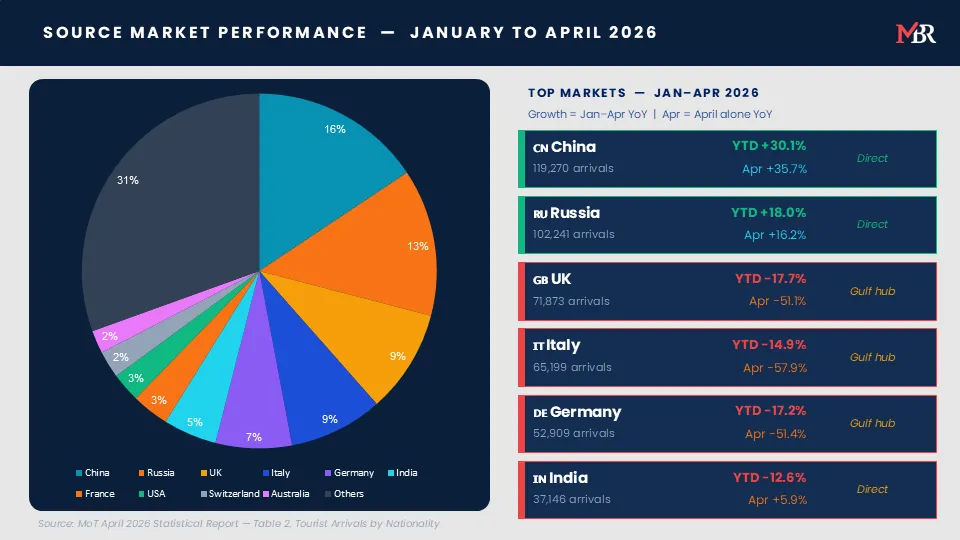
The April nationality data from the official Ministry report confirms this with precision.
European arrivals in April 2026: 80,953 — down 35.9 percent from 126,287 in April 2025. Within Europe, the breakdown is stark: Northern Europe fell 49.9 percent. Southern Europe dropped 59.4 percent. Western Europe declined 41.3 percent.
By country: UK down 51.1 percent. Germany down 51.4 percent. Italy down 57.9 percent. These are the Maldives' most valuable and highest-spending visitor markets.
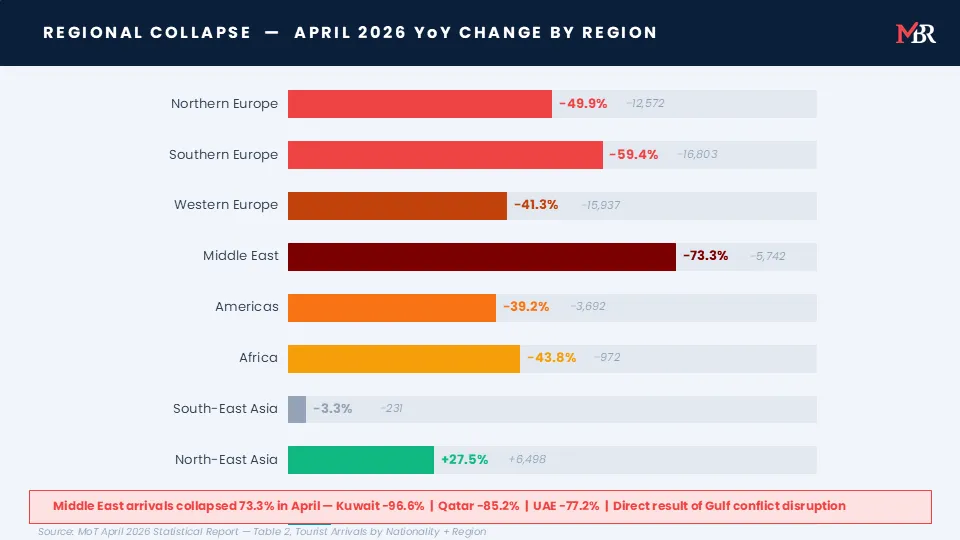
Middle East arrivals collapsed 73.3 percent in April. Kuwait fell 96.6 percent. Qatar fell 85.2 percent. These were previously growing markets. The conflict has effectively suspended them.
The only markets showing growth are those with direct connectivity that are not reliant on Gulf hubs. China grew 30.1 percent for the January-to-April period, and 35.7 percent in April alone — the Maldives' single largest market, with 119,270 arrivals year-to-date, benefiting from direct air links. Russia grew 18.0 percent over the same period. Both countries demonstrate what is possible when routing does not depend on the Gulf.
The Hidden Toll: Occupancy and Bed Nights
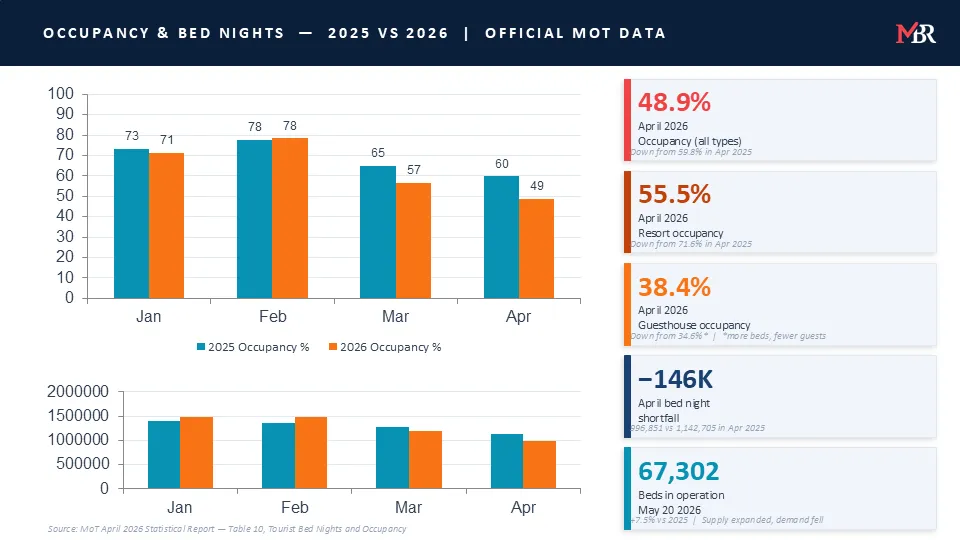
Arrivals are one way to measure the crisis. Occupancy rates are another factor — and in many respects, they are more damaging to operator finances.
Overall resort occupancy in April 2026: 55.5 percent, down from 71.6 percent in April 2025. Overall occupancy across all accommodation: 48.9 percent, against 59.8 percent in April 2025 — a decline of more than 18 percentage points.
Total bed nights in April 2026: 996,851 — against 1,142,705 in April 2025. A shortfall of nearly 146,000 bed nights in a single month.
Critically, the Maldives also expanded its accommodation capacity during this period. Total beds in operation grew 7.5 percent year-on-year, from approximately 62,700 to 67,302. More beds, fewer tourists, and sharply lower occupancy is a financial formula that puts serious pressure on operators — particularly those who borrowed to develop during the post-pandemic boom.
The Guesthouse Sector: Most Exposed, Least Protected
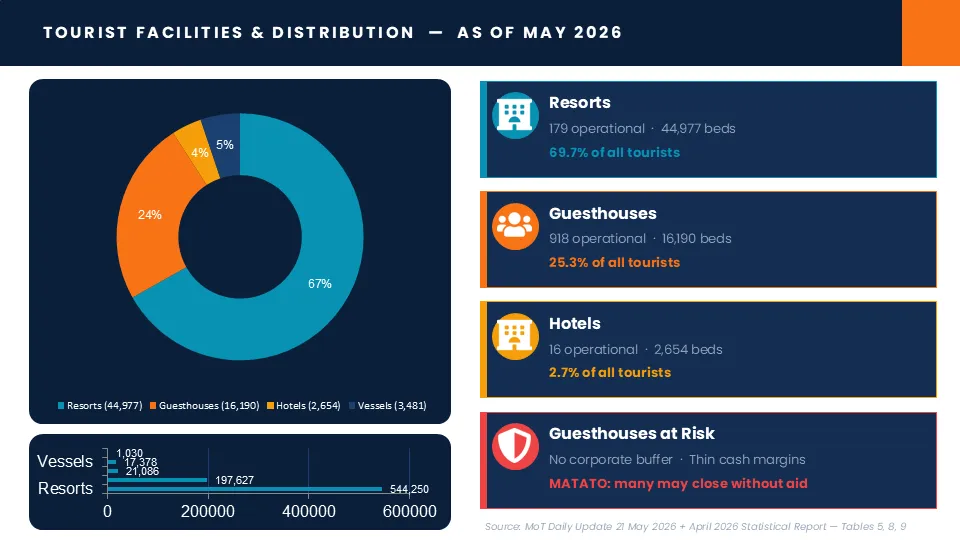
Of 781,369 tourist arrivals from January to April 2026, resorts accommodated 69.7 percent. Guesthouses — 918 properties across 20 atolls, offering 16,190 beds — handled 25.3 percent. That one-in-four share represents a sector that has grown substantially over recent years and now forms the backbone of community island tourism.
But guesthouses operate on fundamentally different economics from resorts. They lack corporate balance sheets, deep-pocketed parent companies, and forward-booking pipelines with international operators. When April occupancy falls below 40 percent and cancellations flood in, there is no buffer. MATATO and NHGAM stated plainly in their May 10 joint statement: many local guesthouses and travel agencies may go out of business without immediate intervention.
Early Signs of Recovery — and Their Limits
UAE airspace has reopened. Turkish Airlines expanded its Istanbul-Malé service to six weekly flights for summer 2026. Edelweiss Air has added Zurich-Malé frequencies for peak season.
These are real improvements. But May data through the 20th still shows an 8.1 percent year-on-year decline against the comparable period in 2025, with a daily average of 6,332 arrivals — well below pre-crisis levels. Recovery is beginning. It has not arrived.
One striking data point: private jet arrivals have surged 166 percent. High-net-worth travellers are bypassing disrupted commercial hubs and flying directly. The Maldives' luxury brand remains intact. That reality, however, does not pay the wages at a guesthouse in Addu Atoll.
What Must Happen Now
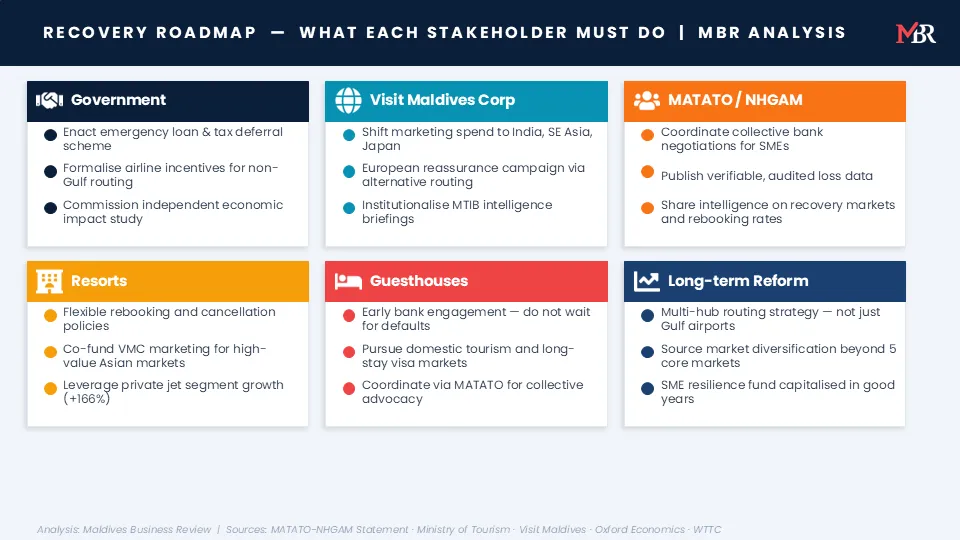
The numbers point to clear priorities across every stakeholder.
Government must move from monitoring to action. Emergency loan facilities, interest-free moratoriums, tax deferrals, and fee waivers for the tourism SME sector — as specifically requested by MATATO and NHGAM — need to be enacted, not studied. Airport fuel pricing, which MATATO identifies as a growing operational burden, requires direct intervention. Airline incentive frameworks for non-Gulf routing through Colombo, Singapore, Istanbul, and Kuala Lumpur must be formalised as policy, not left as aspirational discussions.
Visit Maldives Corporation must redeploy marketing resources toward markets with direct connectivity. India — proximate, massive in outbound travel volume, and not Gulf-dependent — is the most immediately accessible growth opportunity. China and Russia have shown what direct connectivity yields. Southeast Asian markets including Japan, South Korea, and Australia all held relatively well in the April data and deserve targeted investment.
MATATO and NHGAM must keep advocating with evidence and urgency, sharing information together about which markets are recovering, which rebooking strategies are working, and which operators are closest to insolvency.
Resorts with international tour operator relationships must actively work alternative routing and maintain flexible cancellation and rescheduling policies. Losing a booking is recoverable. Losing a guest relationship is not.
Guesthouses must engage their banks early and collectively, pursue the domestic tourism market, and look to the government's proposed long-stay visa categories — remote worker and content creator visas — as emerging segments suited to the authentic island experience the guesthouse sector genuinely offers.
The Structural Lesson
The Maldives ended 2025 with 2,275,088 tourist arrivals, its highest annual total ever. The ambition for 2026 was a further step forward. The data through May 20 points instead to a likely year-end figure closer to 1.9 million, the lowest since the pandemic recovery, unless the second half delivers a substantial reversal.
The deeper lesson is not that the Maldives is a destination in decline. China's 30 percent growth this year — achieved without Gulf transit — proves that when connectivity works, this destination sells itself.
The lesson is that the verified collapse of 42,000 arrivals in March alone and a further 51,000 in April, with losses estimated by MATATO at over USD 500 million (though no independent body has confirmed that figure), represents the cost of routing an entire European market through three airports in a geopolitically volatile region, without alternative corridors, without SME financial buffers, and without source market diversification deep enough to absorb the shock.
That architecture must change. The current crisis has provided both the evidence and the urgency. Whether it also produces the political will to act is the question that will define Maldivian tourism for the decade ahead.
Leave a comment
Comments
No comments yet. Be the first to comment!
Latest News
News
BML Startup Grant recipient The Island Factory expands to over 80 retail outlets
14 Oct 2026
MMA
MMA to introduce new stock of MVR 5 banknotes amid circulation shortage
14 Oct 2026
News
Maldives Expo 2026 exhibitor participation rises 225%
14 Oct 2026
News
Maldives seeks support to strengthen reserves as energy costs push deficit towards 9%
14 Oct 2026