

Features
Maldivian creators flag repeated copyright breaches, exposing enforcement gap in stronger IP regime
Maldivian creators are calling for serious enforcement of copyright laws after fresh allegations that the state broadcaster and political campaigns have repeatedly used original creative work without permission.
27 May 2026, 07:26
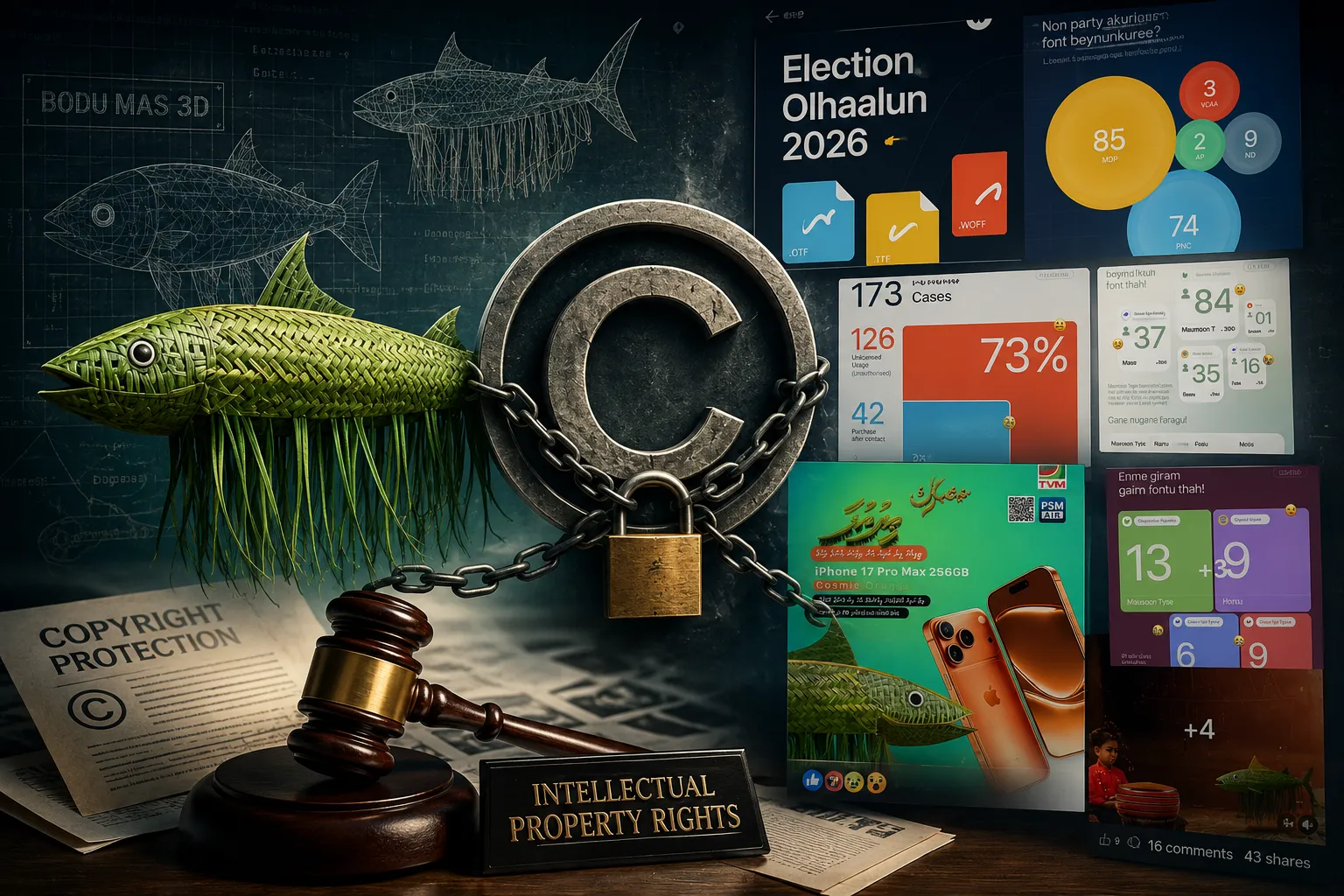
The Maldives now has one of the most complete intellectual property frameworks in its history. The country has a Copyright and Related Rights Act dating back to 2010. Parliament strengthened it in December 2024 with steeper fines and longer protection. The Maldives Intellectual Property Office (MIPO) has been operational since 1 January 2026. The country joined the Berne Convention on 22 November 2025.
Yet local creators say the system is failing the people it was built for.
Two fresh disclosures this month, by 3D artist Hussain Niyaz and by type foundry Akuru Type, point to a problem that is no longer about whether the law exists. It is about whether creators know what their rights are, whether they know how to register and enforce them, and whether the new national IP office has made itself visible enough to do its job.
The two incidents that put the issue back on the table
3D animation artist Hussain Niyaz wrote on Facebook this week that Television Maldives, the channel run by state broadcaster Public Service Media, had again used his original 3D-modelled bodumas without his permission. The bodumas is a traditional Maldivian cultural object, a stylised whale figure crafted from a palm leaf.
In a translation of his Dhivehi post, Niyaz wrote that he had not authorised TVM to use the model. He said it was the second time the broadcaster had used his work without permission. He said his work had a value, that TVM had never supported his creative practice, and that the broadcaster should pay for the unauthorised use.
He appealed to the public for support in pursuing the matter.
Public Service Media has not issued a public response at the time of publication.
In a separate disclosure, Maldivian type foundry Akuru Type said it had reviewed 163 cases of font usage during recent campaigns. Its founder, Abdulla Shafeeu, posted the findings on Facebook.
Shafeeu said that across all parties, only about one in three candidates had properly licensed the fonts they used. The Maldivian Democratic Party (MDP) and Progressive National Congress (PNC) accounted for most of the unlicensed usage by volume. Maumoon Type was the most used typeface, appearing in 84 cases, followed by Roanu, Malas, and Faslu.
After the foundry's outreach, 61 use cases were eventually licensed. More than 200 candidates contacted the platform to verify their font usage.
This is not the first time Akuru Type has gone public. In March 2024, it reported that approximately 90 percent of candidates it approached over unauthorised font use had not cooperated.
A stronger law is already in place
Contrary to what is sometimes assumed, the Maldives does not lack a copyright law. It has had one for more than 15 years.
The Copyright and Related Rights Act (Law 23/2010) protects literary and artistic works, performances, sound recordings, broadcasts, and audiovisual works created in the Maldives. It also protects works from countries party to international IP treaties to which the Maldives is a signatory.
In December 2024, the People's Majlis approved a significant amendment, Act 31/2024, sponsored by Nilandhoo MP Fathimath Saudha of the ruling PNC. According to a summary by Corporate Maldives, the revised law extends copyright protection from 50 to 70 years. It sets fines for infringement between MVR 50,000 and MVR 300,000. It allows criminal penalties of up to approximately USD 19,500 for intentional infringement. Rights holders can also pursue compensation in court.
The amendment widened the scope of protection to explicitly include satellite, internet and cable broadcast content. It preserves educational use as an exception.
On 22 August 2025, the Maldives acceded to the Berne Convention for the Protection of Literary and Artistic Works, with effect from 22 November 2025. The Ministry of Economic Development and Trade announced the accession in a press release. Accession means Maldivian works are now automatically protected in more than 180 Berne member states. Works from those states are equally protected in the Maldives.
In other words, the legal architecture is now in place. The next question is whether the institution that runs it can be reached by the people who need it.
What MIPO is, and what it is supposed to do
The Maldives Intellectual Property Office was formally established under Article 4(a) of the Maldives Intellectual Property Office Act (Law 12/2025). The Act was sponsored by PNC's Kudahuvadhoo MP Hussain Hameed. It was passed at the 23rd sitting of the second session of the 20th People's Majlis on 11 August 2025, ratified by President Dr Mohamed Muizzu on 21 August 2025, and gazetted on the same day.
The Act came into force on 1 January 2026. MIPO is the first single national authority in the country's history dedicated to intellectual property.
Under Section 5 of the Act, MIPO's responsibilities and powers cover the full lifecycle of IP administration. The office is responsible for registering all classes of intellectual property recognised under Maldivian law. These include trademarks, copyright, patents, industrial designs, and geographical indications. MIPO maintains the national IP register and keeps it current.
The Act also requires MIPO to establish links with regional and international IP organisations and seek their technical assistance. It must coordinate Maldivian participation in international IP treaties and ensure the country meets its obligations. It must monitor regional and international developments in IP law and practice. It must run public awareness programmes on IP rights. It must provide services under the IP laws and collect prescribed fees.
The office is headed by a Registrar of Intellectual Property. Under Section 6, the Registrar is the most senior officer of the office. Under Section 7, the Registrar is appointed by the Minister of Economic Development and Trade. The Act required the Minister to appoint a Registrar within 30 days of the law coming into force. That deadline expired on 31 January 2026. The appointment of the current Registrar has not been the subject of widely circulated public news coverage to date, and the Ministry's communications channels would be the appropriate place to confirm the name.
The Registrar serves a 5-year term, renewable once. Under Section 8, the Registrar must be a Maldivian citizen, hold a first degree in IP, a related field, or law, and have at least 5 years of management experience. The Registrar may not concurrently hold a political party position or any other state employment.
Under Section 15, the Registrar and all MIPO staff are required to act with professional independence, free from political or any other influence.
Importantly for the present discussion, Section 32 of the Act transfers a specific responsibility from the Ministry to MIPO. All copyright registration functions that previously sat with the Ministry under Section 38 of the Copyright Act 23/2010 now sit with the Registrar of Intellectual Property. This includes the registration of copyright and related rights, the maintenance of the register of copyright holders, and related administrative duties.
In practical terms, this means that since 1 January 2026, a Maldivian creator who wishes to formally register a copyrighted work is supposed to do so through MIPO, not through the Ministry directly.
The President's Office, through Directive No. 02/2026, has assigned MIPO the official correspondence reference number 1136.
Under Section 33 of the MIPO Act, the Registrar is required to make all regulations under the law within 6 months of the Act coming into force. That deadline falls on 1 July 2026. These regulations will set out the application procedures, fee schedules, electronic filing systems, dispute review mechanisms, and complaints processes. Until they are published, the day-to-day mechanics of how a creator actually files a copyright registration with MIPO remain administrative rather than fully codified in a public-facing form.
How copyright registration is supposed to work
The Copyright Act 23/2010 is structured around an automatic protection model. Under Section 2 and surrounding provisions, a work is protected from the moment it is created and fixed in a medium. Registration is not a precondition for protection.
This is consistent with the Berne Convention, which the Maldives joined in November 2025. Under Berne, copyright exists automatically upon creation and does not require registration in any member state.
What registration does is provide formal evidence. As the Act notes, the main purpose of registering a work is to give the creator a means of demonstrating ownership in a court of law if the work is later infringed. An unregistered work is still protected. A registered work is easier to defend.
Before 1 January 2026, copyright registration applications went to the Ministry of Economic Development and Trade under Section 38 of the Copyright Act. Since 1 January 2026, by virtue of Section 32 of the MIPO Act, those applications go to the Registrar of Intellectual Property at MIPO.
To register a copyrighted work, a creator generally needs to fix the work in a tangible medium. This may be a digital file, a written document, a recorded audio or video file, a photograph of a physical artwork, or other reproducible form. The applicant typically files a registration request that identifies the work, the author, the date of creation, the medium, and the nature of the rights claimed. Supporting documentation, such as design files, drafts, or prior publication records, helps establish authorship.
For a 3D modelled cultural object like Niyaz's bodumas, this would mean submitting the 3D file along with development records that show the model was the artist's original creation. For Akuru Type's fonts, registration would cover the typeface design files and their associated metadata. For songwriters, photographers, illustrators, and screenwriters, the principle is the same.
Once registered, the rights holder has a documented basis to assert their rights against infringers under both Maldivian law and, by virtue of the Berne Convention, under the laws of any other Berne member state.
The specific forms, fees, and processing timelines that MIPO will require for copyright registration are expected to be published with the Section 33 regulations by 1 July 2026.
The visibility and awareness gap
This is where the Niyaz and Akuru Type cases become important. Both creators have made their concerns public on social media. Neither has indicated they have a clear route into the new institutional framework that is supposed to support them.
At the time of publication, no public-facing MIPO website was located in standard searches. The President's Office press release of 1 January 2026 confirmed the establishment of the office but did not announce a public web portal, a public contact number beyond the correspondence reference 1136, or a public-facing process guide for creators wishing to register their work or report infringement.
For a copyright system to function in practice, three things must reach the creator. First, the creator must know that the law exists and what it covers. Second, the creator must know how to register and enforce their work. Third, the institutions, companies, political parties and state actors who use creative content must know that they are bound by the same law as everyone else.
Awareness programmes are a statutory responsibility of MIPO under Section 5(ޅ) of the MIPO Act. The office is required to conduct programmes that educate the public about IP rights granted under Maldivian law. To date, no large-scale public campaign by MIPO has been reported in local press.
The result is a paradox. The Maldives is now a Berne Convention country, with a strengthened Copyright Act and a dedicated national IP office, yet creators continue to report unauthorised use of their work by state broadcasters and political campaigns, and continue to do so on Facebook because there is no widely known formal channel.
What comparable economies do
Small and middle-income economies that depend on cultural and creative industries have built mechanisms that go beyond simply having a law and an office.
Mauritius, an Indian Ocean economy of comparable scale, passed its current Copyright Act in 2014. It operates the Mauritius Society of Authors (MASA), a collective management organisation that licenses works on behalf of rights holders, collects royalties, and distributes them, according to legal analysis published by S.S. Rana & Co. The Ministry of Arts and Culture is also building a public register of copyright owners, assignees and licensees.
Seychelles regulates copyright under its Copyright Act (Chapter 51). It is a Berne signatory and provides a national registration option.
Singapore, a much larger economy but a leading regional model, has used collective management as a core part of its creative economy strategy. The Intellectual Property Office of Singapore co-hosted a regional Asia-Pacific workshop on collective management in November 2023, attended by 13 member states, with the World Intellectual Property Organization (WIPO).
WIPO itself recommends that small economies set up collective management organisations to handle licensing at scale. It provides a free software platform, WIPO Connect, to help smaller CMOs operate at international standard. The Maldives has access to this support as a WTO and Berne member.
The lesson from these jurisdictions is that the law is a floor, not the building. The actual day-to-day functioning of copyright protection depends on collective licensing bodies, public registers, awareness campaigns, and accessible registration and complaints procedures.
What creators are asking for
The Maldivian creators raising these issues are not, for the most part, asking for new laws. They are asking for the existing framework to function in a way that is visible, accessible, and enforced.
Their asks, drawn from the public statements of Niyaz, Akuru Type and others, are practical. First, that institutions that use creative work, particularly state broadcasters, political parties, ministries and SOEs, recognise that creative work has commercial value and must be licensed before use. Second, that MIPO publishes accessible information on how to register copyright, how to record licences, and how to report infringement. Third, that MIPO conducts visible awareness programmes that reach creators, candidates, advertising agencies, government procurement officers, and broadcasters.
A workable additional step, drawing from Mauritius and the WIPO recommendation, would be the establishment of a Maldivian collective management organisation for visual, design and audiovisual rights. MIPO, now operational, has the legal mandate to support and recognise such a body under its international cooperation function in Section 5 of its Act.
For the political class, the issue is sharper than for ordinary commercial users. Parliamentarians who legislate IP protections, then use protected work without licensing during their own campaigns, expose a credibility gap that the public can see. Both major parties have featured in Akuru Type's findings.
For state broadcasters, the reputational and legal risk is concrete. Public Service Media is publicly funded and is widely regarded as a benchmark in the Maldivian media environment. Repeated allegations from independent creators that their work has been used without permission undermine that role and, under the amended Copyright Act, expose the broadcaster to substantial financial penalties.
For private companies, the calculation is simple. The cost of licensing a font, a photograph, an illustration or a 3D model is almost always far lower than the legal and reputational exposure that can follow infringement under the amended law.
Until MIPO becomes a public-facing institution that creators can find, contact and use, and until awareness reaches the procurement and design teams that commission and reuse creative work, the practical burden of policing infringement will continue to fall on the very people the system is designed to protect.
Leave a comment
Comments
No comments yet. Be the first to comment!
Latest News
MMA
Maldives Completes USD 50 Million Treasury Bill Repayment as Official Reserves Stand at USD 547 Million
14 Oct 2026
News
BML Startup Grant recipient The Island Factory expands to over 80 retail outlets
14 Oct 2026
MMA
MMA to introduce new stock of MVR 5 banknotes amid circulation shortage
14 Oct 2026
News
Maldives Expo 2026 exhibitor participation rises 225%
14 Oct 2026