

Features
Non-tax revenue base shifts toward tourism assets as SOE dividends and one-off fees retreat
The composition of Maldivian government non-tax revenue is shifting toward tourism-linked asset income and away from state enterprise dividends and one-off administrative fees, according to the Ministry of Finance and Public Enterprises.
30 May 2026, 13:38
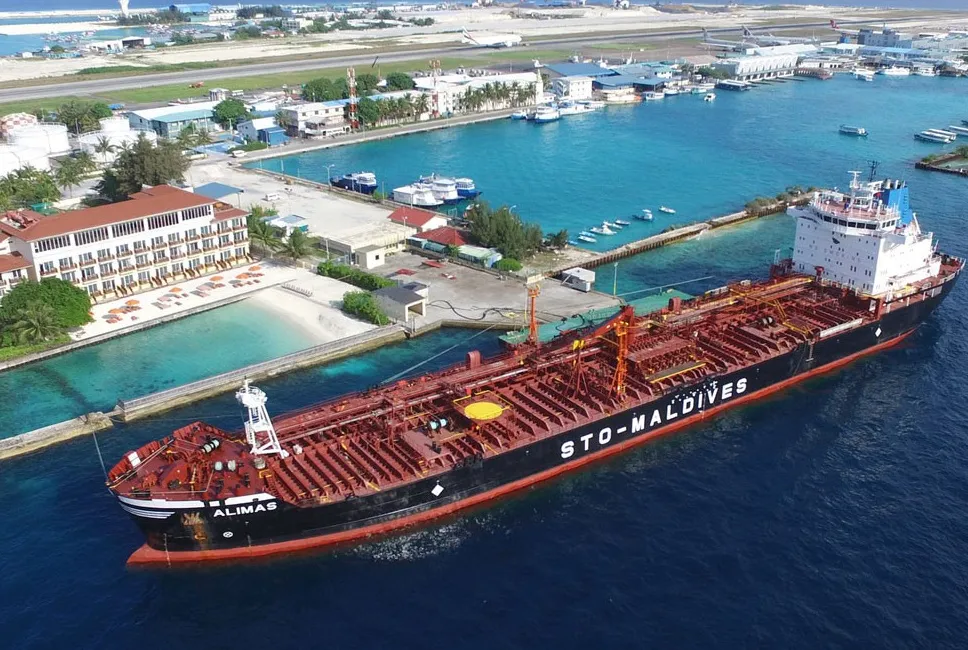
The composition of the Maldivian government's non-tax revenue is undergoing a measurable structural shift in 2026, with tourism-linked asset income rising sharply while state-owned enterprise dividends and discretionary administrative fees retreat. The pattern, visible in the Ministry of Finance and Public Enterprises' Weekly Fiscal Developments report for week 19, has fiscal implications that extend beyond the headline numbers.
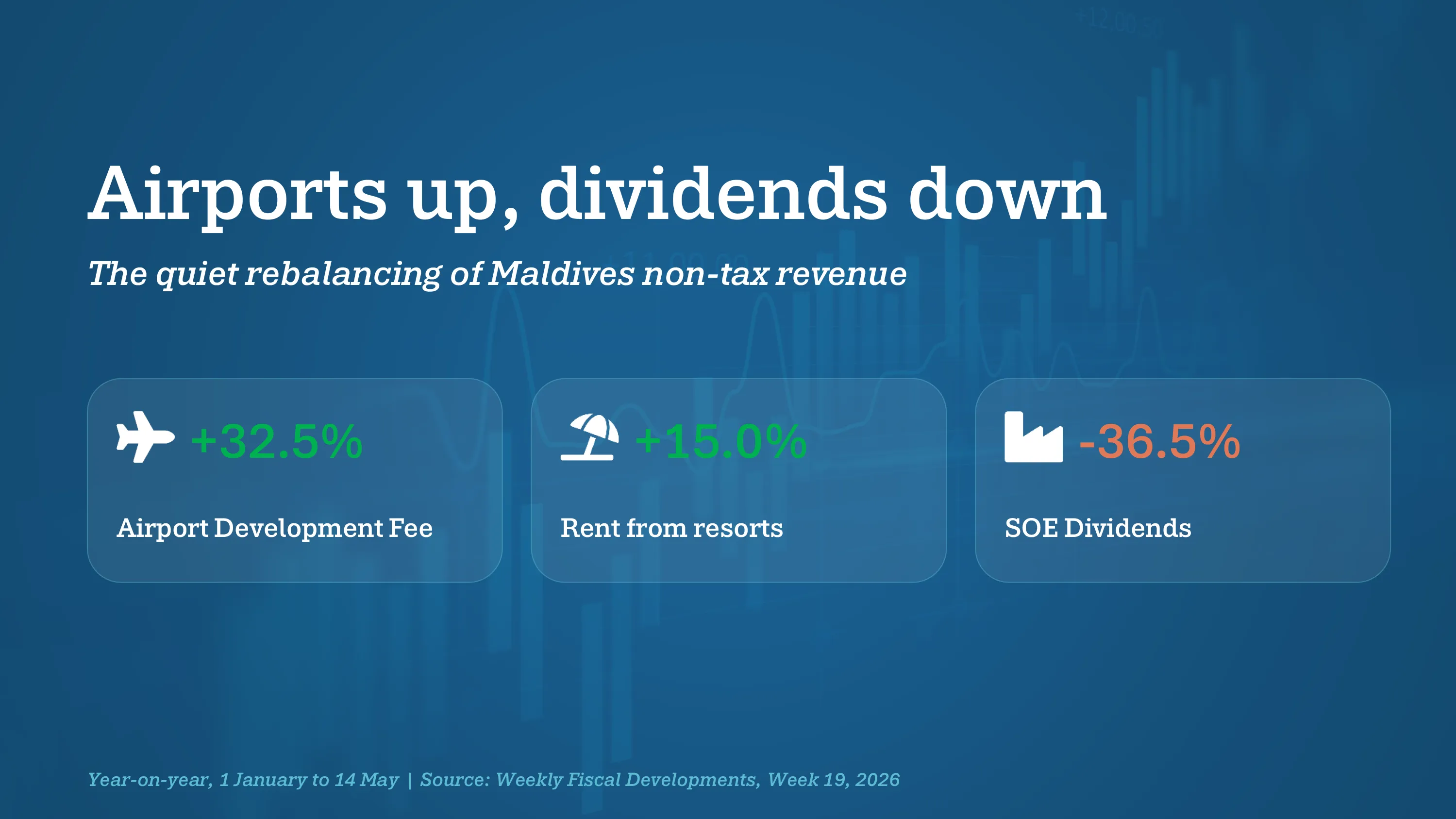
Total non-tax revenue collected between 1 January and 14 May 2026 stood at MVR 3,370.9 million, slightly below the MVR 3,495.1 million collected in the same period of 2025. The 3.6 percent decline masks a more significant rotation in the underlying revenue mix. Six revenue lines posted year-on-year gains. Five posted declines. The compositional change matters more than the topline.
Where revenue grew
Property income recorded the largest absolute increase. Collections rose to MVR 1,052.5 million, up MVR 389.7 million, or 58.8 percent year on year. The category captures rent from resort island leases and fees from land transactions, both of which are sensitive to tourism sector activity and real estate liquidity.
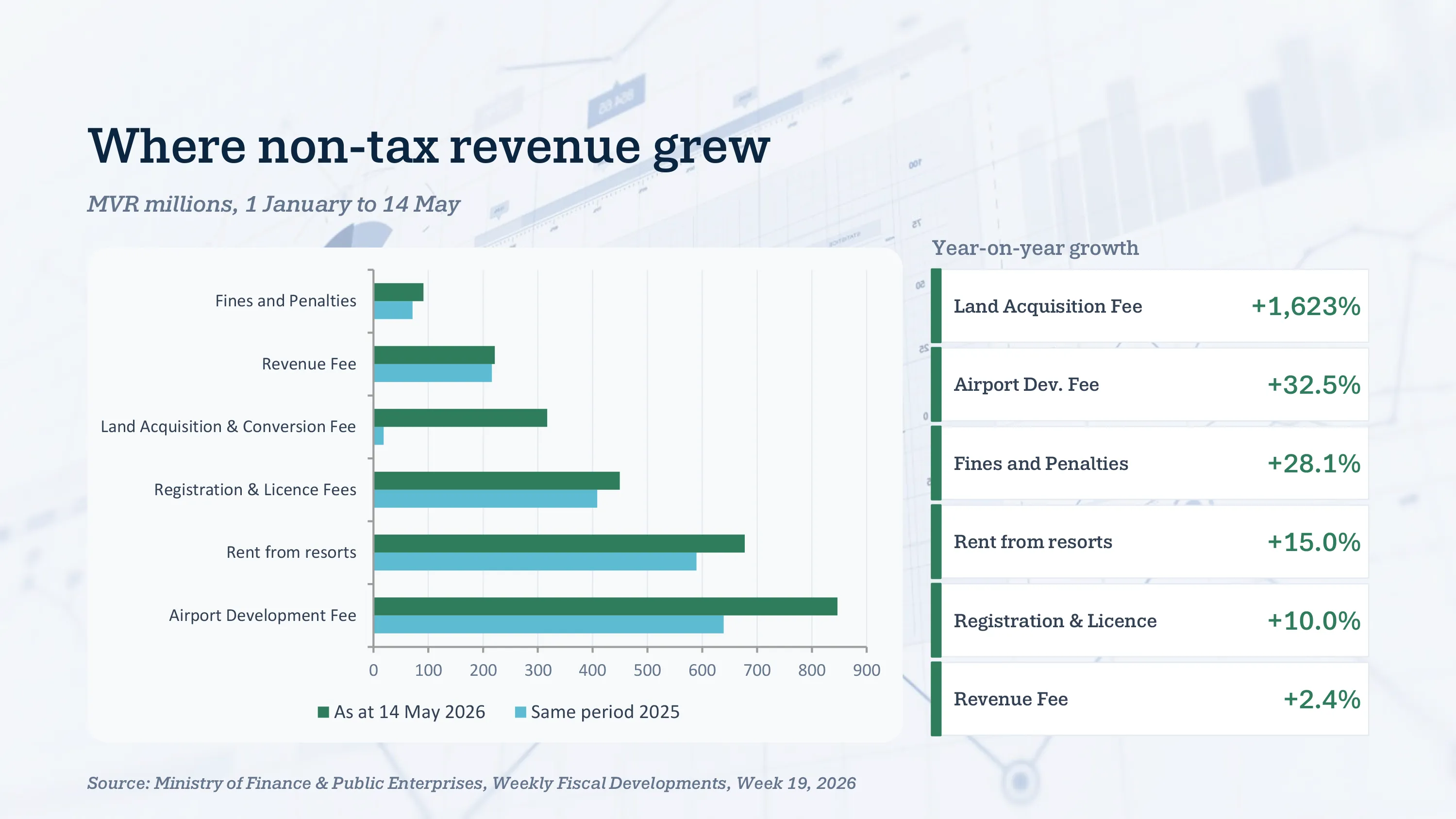
Within property income, the Land Acquisition and Conversion Fee posted the most striking single movement in the entire non-tax table. The line generated MVR 317.2 million in the period, compared with MVR 18.4 million in the same window of 2025. The increase of MVR 298.8 million represents growth of more than 1,600 percent. The Ministry of Finance has not detailed the underlying transactions in the weekly report, but the scale points to one or more high-value land conversion or acquisition arrangements settling during the period.
Rent from resorts climbed to MVR 677.6 million from MVR 589.3 million, an increase of MVR 88.3 million or 15.0 percent. The rise reflects the continued strength of the resort lease portfolio and is consistent with sustained tourist arrival volumes.
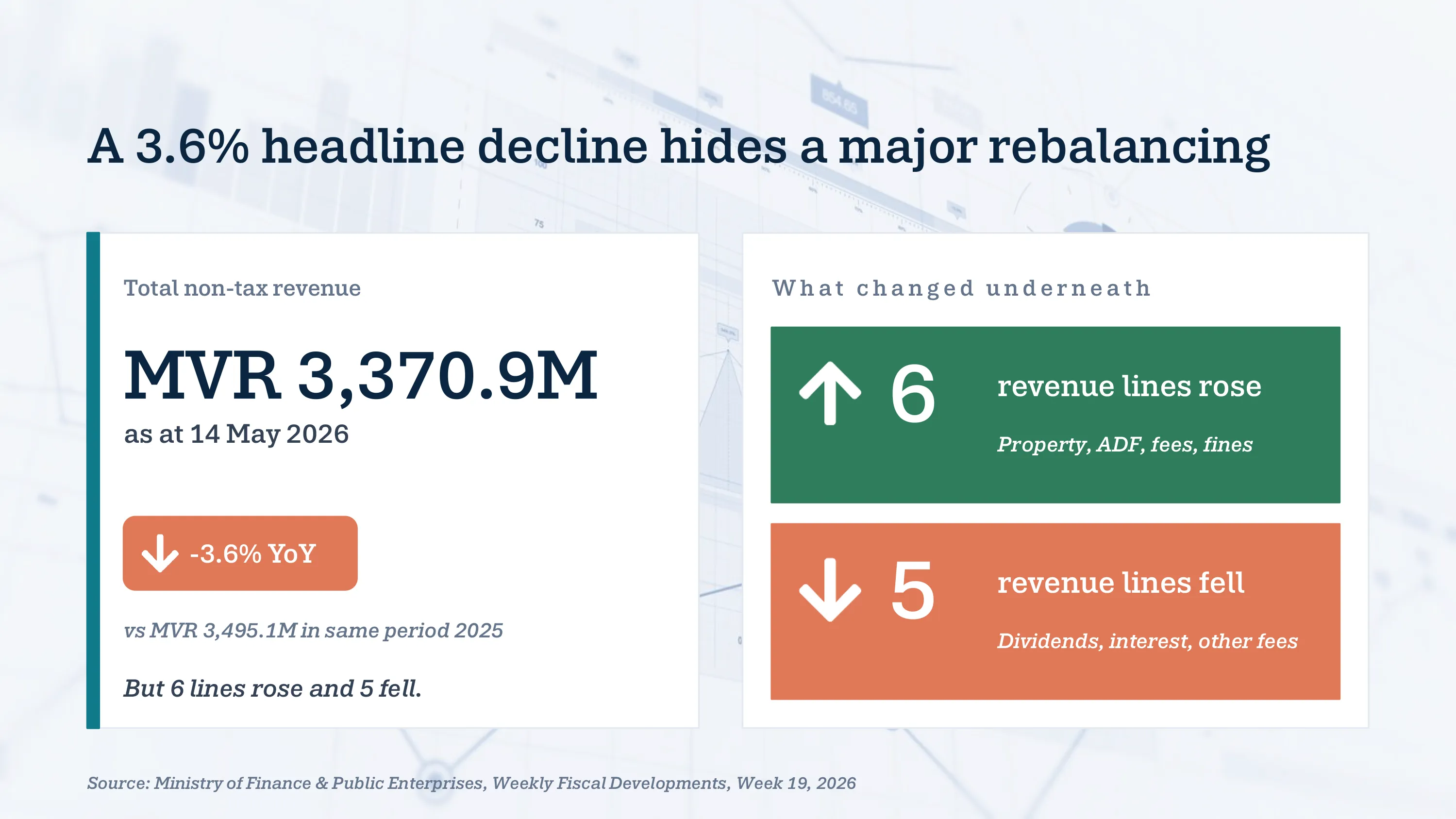
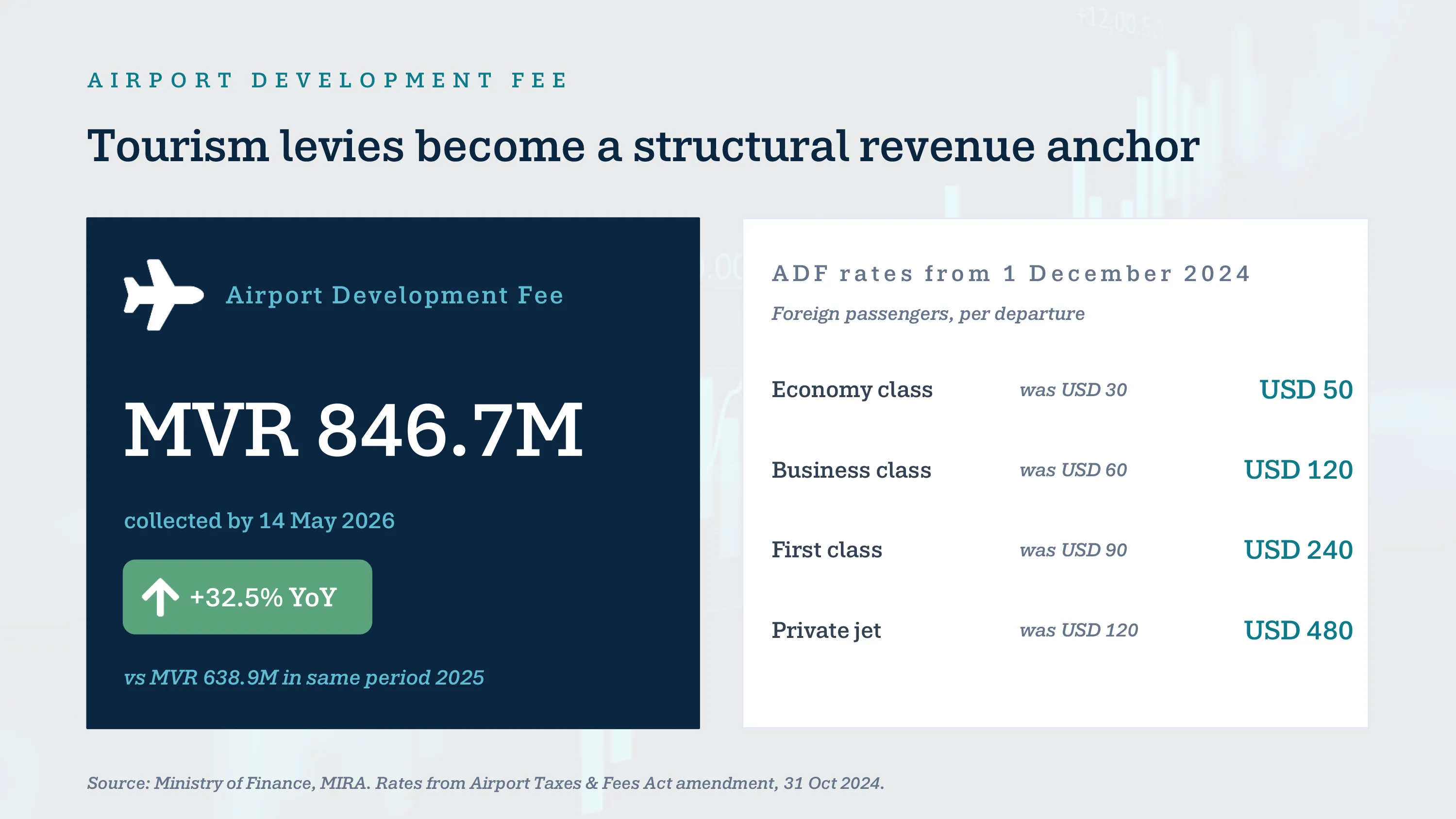
The Airport Development Fee delivered the second-largest absolute gain in the non-tax category. Collections reached MVR 846.7 million, up MVR 207.8 million from MVR 638.9 million, an increase of 32.5 percent year on year. The growth follows the restructuring of departure-related charges approved by Parliament on 31 October 2024 and brought into effect on 1 December 2024. Under the revised schedule, foreign economy class passengers pay USD 50 in ADF, business class passengers pay USD 120, first class pays USD 240, and private jet passengers pay USD 480. Maldives Inland Revenue Authority data published earlier this year showed ADF collections in January 2026 up 60.6 percent against January 2025.
Registration and Licence Fees rose 10.0 percent to MVR 449.4 million. Fines and Penalties climbed 28.1 percent to MVR 91.2 million. The Revenue Fee grew marginally to MVR 221.3 million from MVR 216.2 million. Other Rent and Property Income gained MVR 2.7 million to reach MVR 57.7 million.
Where revenue contracted
The largest absolute decline in any non-tax revenue line came from the Other Fees and Charges category. The line collected MVR 246.9 million in the period, down from MVR 829.7 million in 2025. The drop of MVR 582.8 million, or 70.2 percent, more than offset most of the gains elsewhere in the non-tax category. Other Fees and Charges captures residual administrative fees that fluctuate based on one-off transactions and discretionary collections. The 2025 comparison base appears to have included unusually large items not repeated in 2026.
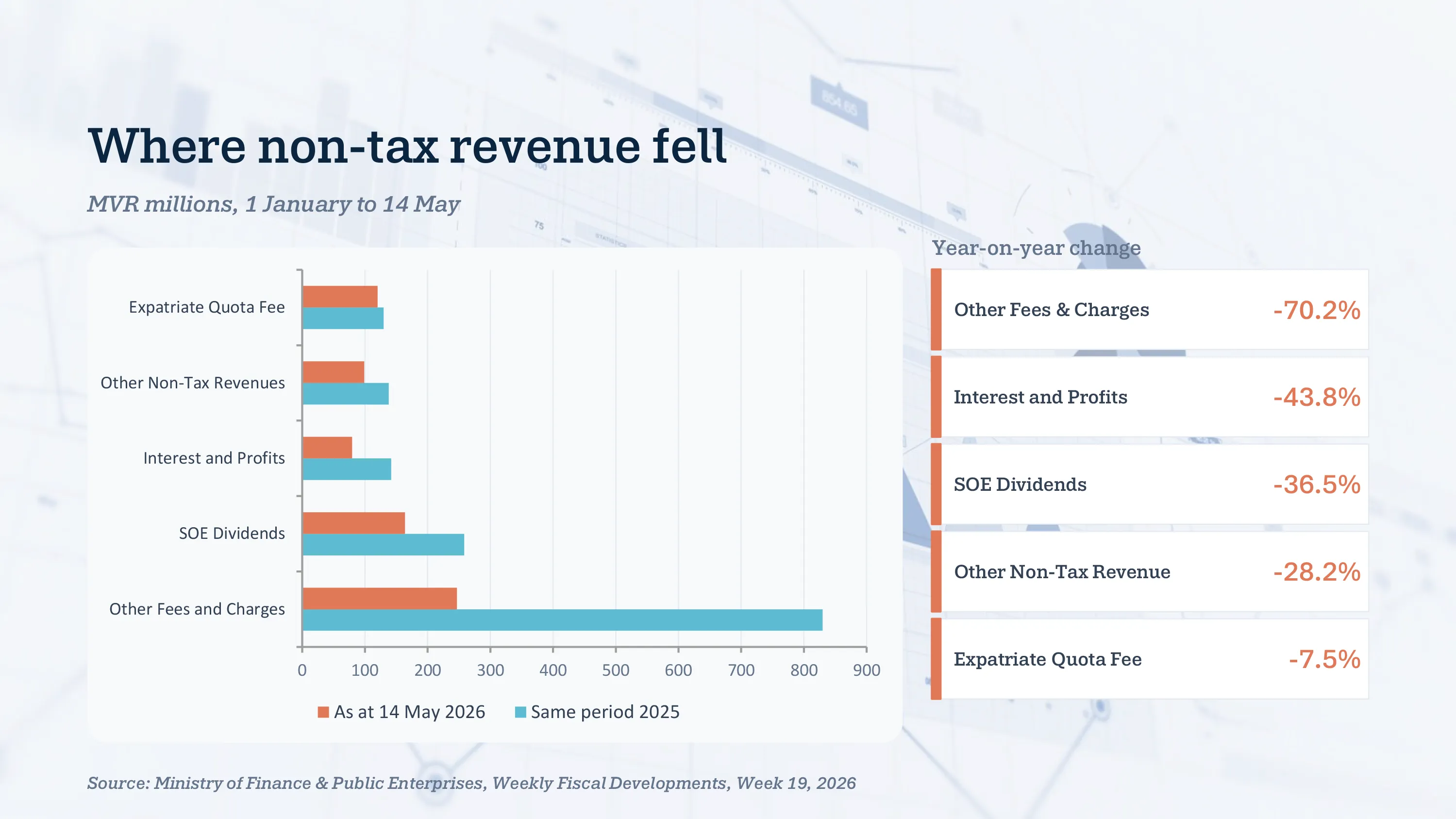
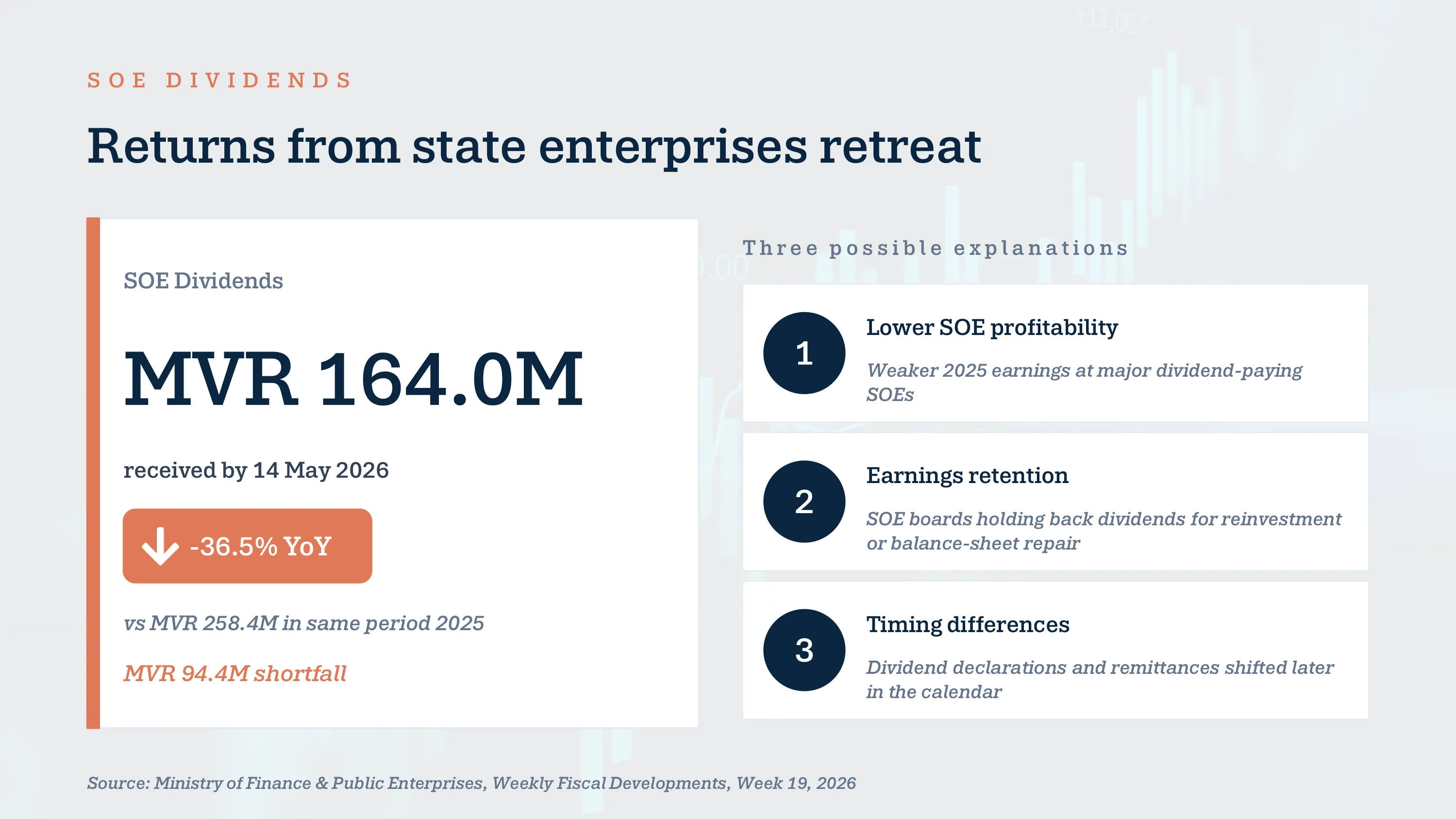
SOE Dividends fell to MVR 164.0 million from MVR 258.4 million in the same period last year. The decline of MVR 94.4 million, or 36.5 percent, indicates that the state is receiving less return from its enterprise holdings during a period in which the parent budget faces heavy debt servicing demands.
Interest and Profits, the second sub-line under Interest, Profit, and Dividends, fell to MVR 79.7 million from MVR 141.7 million. The decline of 43.8 percent reflects lower returns on government cash balances, consistent with the drawdown of the Sovereign Development Fund and official reserves to settle the USD 500 million sukuk obligation in April.
Overall, the Interest, Profit, and Dividends category fell by MVR 156.5 million, a 39.1 percent drop that is the largest percentage decline among the major non-tax sub-categories.
Other Non-Tax Revenues declined to MVR 99.0 million, down 28.2 percent. The Expatriate Quota Fee softened to MVR 120.3 million from MVR 130.0 million, a fall of 7.5 percent.
What the pattern means
The data discloses a meaningful rebalancing in how the Maldivian state earns its non-tax income.
First, the revenue base is becoming more tourism-linked and more structural. The Airport Development Fee, resort rent, and Green Tax (reported separately under tax revenue) are levies tied to tourism volumes and tourism asset use. They are predictable, foreign-currency-earning, and respond to capacity rather than to political or administrative discretion. The continued growth of ADF and resort rent strengthens the state's reliance on the tourism sector as a fiscal anchor.
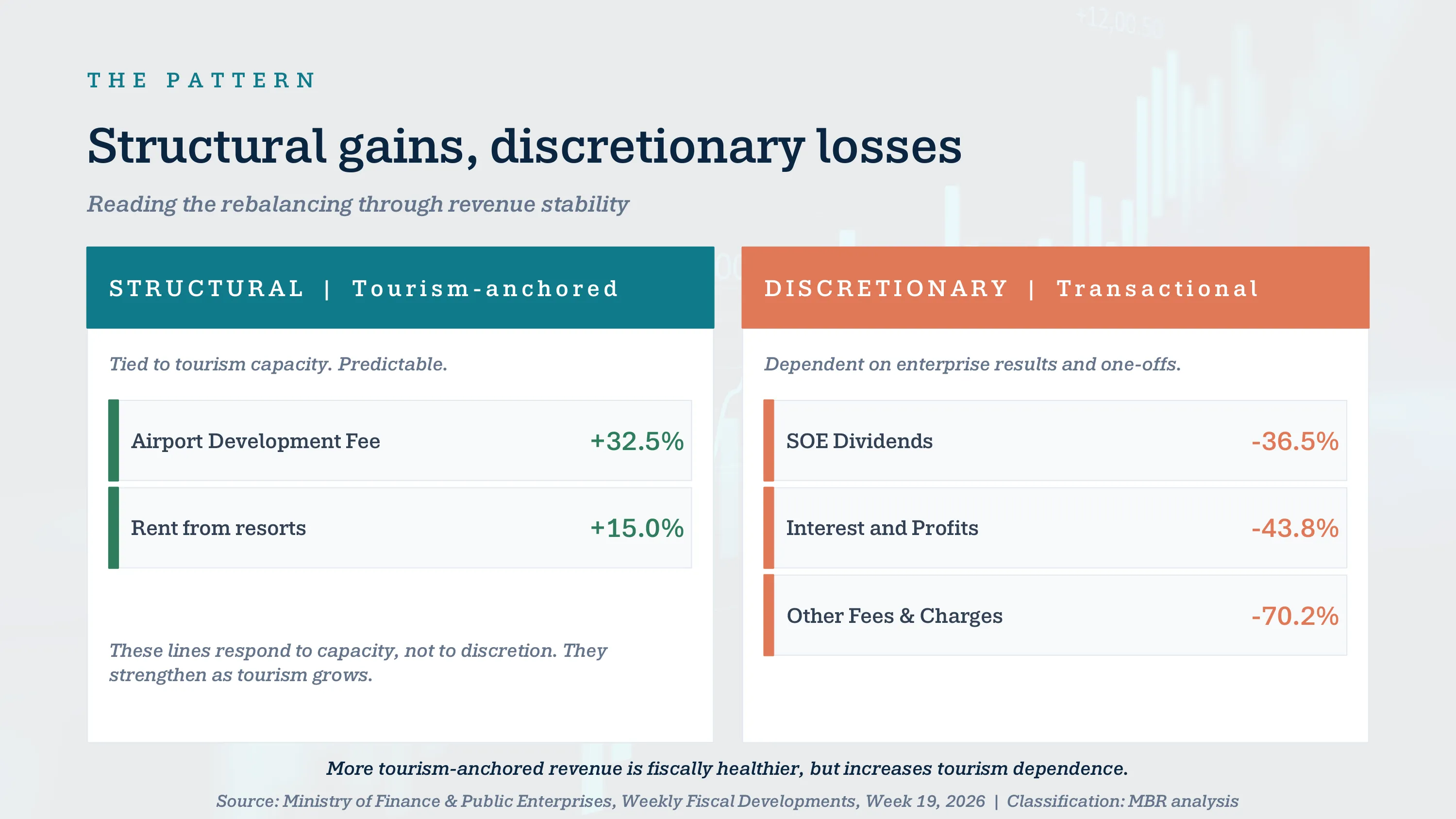
Second, the SOE dividend retreat raises a structural question. State-owned enterprises, including the Bank of Maldives, the State Trading Organisation, Maldives Transport and Contracting Company, and Maldives Airports Company, are major dividend contributors in normal years. A 36.5 percent decline in early-year SOE dividend remittances may reflect lower 2025 profitability among the dividend-paying enterprises, retention of earnings for reinvestment or balance-sheet repair, or timing differences in dividend declarations. Each explanation carries different fiscal implications. Reduced SOE profitability would suggest enterprise-level weakness in a sector that has historically required substantial state support. Earnings retention would suggest balance-sheet caution by SOE boards. The Auditor General's Office and individual SOE financial statements are the relevant sources for resolving the question.
Third, the collapse in Other Fees and Charges illustrates the volatility of relying on discretionary administrative income. Lines that depend on episodic transactions cannot be projected with the same confidence as structural levies. The 70.2 percent year-on-year drop in this single line was sufficient to push the overall non-tax category into negative growth territory.
Fourth, the Land Acquisition and Conversion Fee surge has both fiscal and policy dimensions. The increase from MVR 18.4 million to MVR 317.2 million is highly concentrated and points to a small number of significant land transactions. Sustained levels of this kind would require continued real estate activity. A return to baseline levels in subsequent periods would mean the 2026 non-tax revenue trajectory is overstated by a one-off effect.
The cumulative picture is of a non-tax revenue base that is gaining structural support from tourism assets while losing ground in returns from state enterprises and administrative collections. The fiscal authorities will be aware that the non-tax line, although smaller than tax revenue, is the more concentrated and more volatile of the two. Its trajectory will affect how comfortably the state meets its 2026 financing needs.
The Ministry of Finance publishes the Weekly Fiscal Developments report each week. Figures are provisional pending reconciliation.
Leave a comment
Comments
No comments yet. Be the first to comment!
Latest News
MPL
Maldives Ports completes first AI literacy training under Digital for All campaign
18 Oct 2026
MMA
MMA delegation participates in IMF-World Bank Annual Meetings in Bangkok
18 Oct 2026
News
The pension office aims to double fund to MVR 60 billion within five years, CEO says
18 Oct 2026
News
Maldives Expo 2026 adds international exhibitors district
17 Oct 2026