

Features
Bangladesh lifts e-cigarette ban as Maldives doubles down: an economic comparison.
Dhaka has reopened a regulated market for vapes and heated tobacco. Malé is moving in the opposite direction, with revenue, smuggling, and harm-reduction questions left unresolved.
Sham'aan Shakir
24 May 2026, 10:19
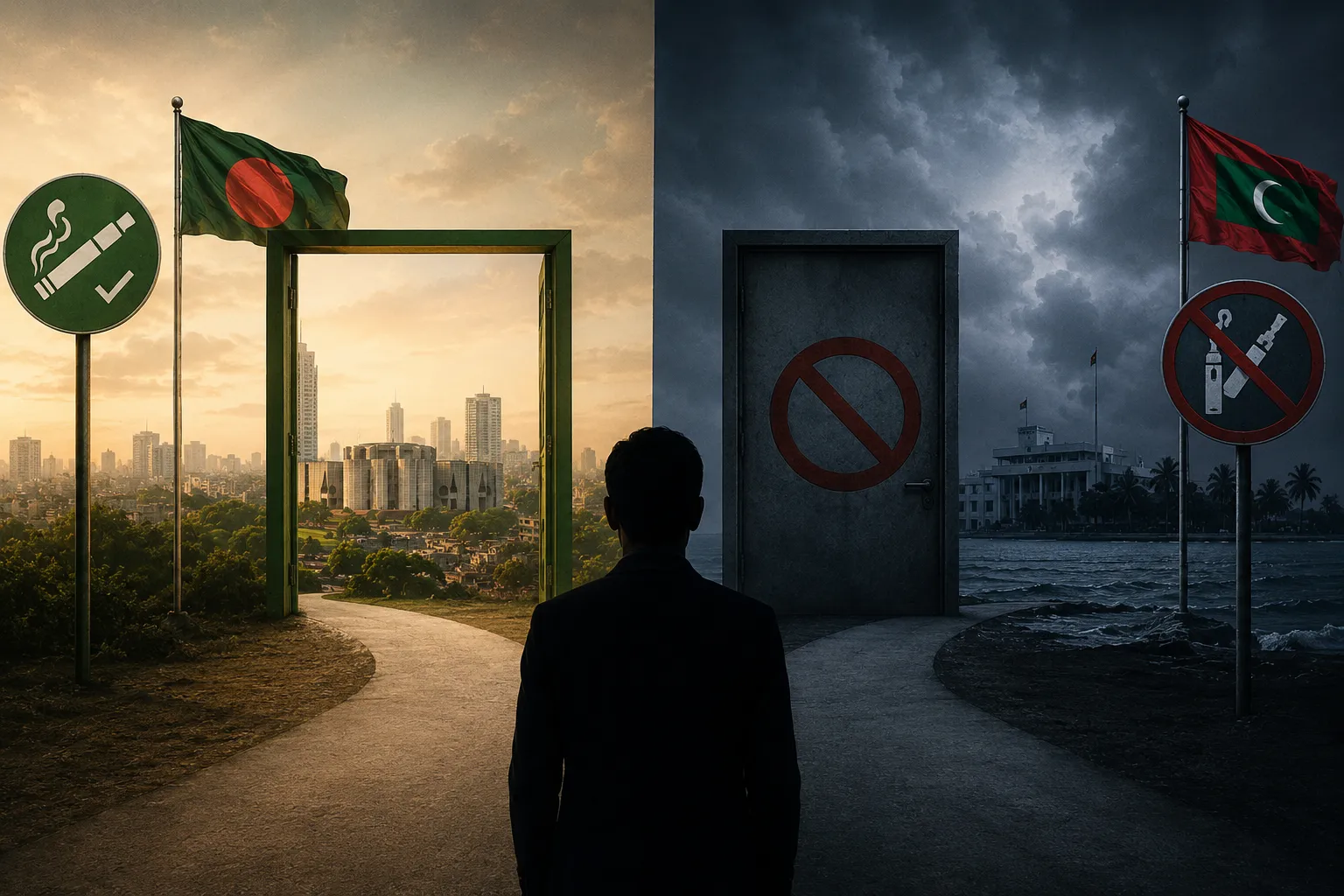
Bangladesh has formally withdrawn its ban on e-cigarettes and heated tobacco products, opening a regulated market that policymakers in Dhaka argue could help millions of smokers move away from combustible cigarettes. The amended Smoking and Tobacco Products Usage (Control) Act, 2026, was gazetted on 10 April 2026 after passing parliament, according to Bangladeshi daily Prothom Alo and industry tracker Tobacco Reporter.
The reversal comes less than four months after Bangladesh's interim government banned the same products under the Smoking and Tobacco Products Use (Control) (Amendment) Ordinance, 2025, promulgated on 31 December 2025. A parliamentary committee reviewing 133 interim-government ordinances recommended removing the e-cigarette provisions.
The policy shift in Dhaka has sharpened a question for the Maldives. The country, with a smaller population and a tourism-driven economy, has moved in the opposite direction.
Maldives policy
The Maldives banned the import of vapes from 15 November 2024 and prohibited possession, use, sale, manufacture, advertising, and distribution from 15 December 2024. President Dr. Mohamed Muizzu ratified the first amendment to the Tobacco Control Act on that timeline, following recommendations from the Maldives NCD Alliance, the Doctors Association, and the Nurses Association. The World Health Organization welcomed the decision.
In parallel, the 19th Amendment to the Export-Import Act, effective 1 November 2024, set a 200 percent import duty on tobacco, prepared tobacco products, e-cigarettes, vaping devices, and heated tobacco devices, according to the President's Office. Cigarette-specific duty was raised from MVR 60 to MVR 160 per pack of 20, pushing retail prices from MVR 110 to MVR 250.
On 1 November 2025, the Maldives went further, becoming the first country in the world to enforce a "generational" tobacco ban. Anyone born on or after 1 January 2007 cannot legally buy tobacco products in the country, including tourists. Ahmed Afaal, vice chair of the Tobacco Control Board, told Euronews the measure would not deter visitors, saying people do not come to the Maldives in order to smoke.
Public health case
Health authorities in Malé have framed the policy as a youth protection measure. The 2019 Global Youth Tobacco Survey found that 23.1 percent of boys and 10.7 percent of girls aged 13 to 15 in the Maldives had used e-cigarettes. The Maldives NCD Alliance has said that 84 percent of deaths in the country are caused by non-communicable diseases, with tobacco a leading contributor.
The Ministry of Health has said the bans are intended to prevent the normalisation of nicotine use among children and adolescents.
The Bangladesh argument
Supporters of Bangladesh's reversal point to harm reduction. Research cited by the U.S.-based Consumer Choice Center, reported by FM Live, estimated that 6.2 million Bangladeshi smokers could potentially quit if regulated lower-risk alternatives were available. The amended Bangladeshi law retains restrictions on advertising, sales to minors, and use in public places, while permitting a controlled market.
The WHO's position remains cautious. Its Global Tobacco Epidemic Report 2021, cited by Prothom Alo, states that e-cigarettes contain nicotine, that nicotine harms adolescent brain development, and that users of e-cigarettes are more likely to take up conventional smoking. The harm-reduction debate is therefore not settled internationally.
Economic picture in the Maldives
The fiscal effects of the Maldives' tobacco strategy have begun to appear in official data.
Customs duty collection stood at MVR 2.79 billion as of 27 November 2025, against an annual target of MVR 4.58 billion, according to Finance Ministry figures reported by Sun. The figure was 12.8 percent below the same period in 2024, when revenue was MVR 3.20 billion. The Ministry has attributed part of the shortfall to falling legal cigarette sales after the duty hike.
In the 2026 state budget passed by the PNC-controlled parliament, projected import duty revenue has been reduced by 32 percent to MVR 3.13 billion. The Auditor General's Office has flagged MVR 606 million owed to Customs in unresolved tobacco duty cases and fines.
Enforcement data also indicate a parallel illicit market. In October 2024, Customs intercepted more than 8,000 cartons of illegal cigarettes in a single operation, according to reporting by Maldives Independent. The Maldives Police Service has reported MVR 127,000 in vape-related fines in July 2025 alone, covering use, possession, and sale offences.
Traders quoted in Maldivian and international media have warned that smuggling and self-made cigarettes have increased, and that some former vapers may return to combustible tobacco.
Tourism and trade considerations
Tobacco and nicotine products are a small but consistent line item in Maldivian imports. UN Comtrade data shows the country imported around USD 25,000 worth of cigars and cigarettes from Greece alone in 2024, alongside larger volumes from other markets. The tourism sector, which generates the bulk of foreign currency earnings, operates under the same rules, with limited duty-free allowances for tourist visa holders.
Industry analysts note that any future review of the ban would need to weigh customs revenue, public health outcomes, smuggling enforcement costs, and tourism market positioning, given that the Maldives now markets itself as a strict tobacco-control jurisdiction.
Outlook
The Ministry of Health has not signalled any plan to follow Bangladesh's lead. Government officials have repeatedly described the generational tobacco ban and the vape prohibition as long-term public health commitments rather than revenue measures.
Whether the Maldives can hold that position while customs revenue contracts, illicit trade expands, and a regional neighbour pivots toward regulated nicotine alternatives will be one of the defining policy questions of the coming budget cycles.
Editor’s note: Maldives Business Review is collaborating with Mirus Media on a campaign to combat smoking. This article is part of a series published as part of that campaign.
Leave a comment
Comments
No comments yet. Be the first to comment!
Latest News
News
MIRA collects MVR 2.69 billion in September, 12.7% above forecast
12 Oct 2026
News
BML Earns Global Recognition on Forbes’ World’s Top Performing Banks 2026 List
12 Oct 2026
Ooredoo Maldives
Ooredoo Maldives offers 10 free registration slots for Doha Marathon 2027
12 Oct 2026
News
Vietjet flights to offer Maldivians new travel options from December
12 Oct 2026