

Features
"Make it make sense": Maeesha Asif reframes the Gen Z workplace debate
At the 6th MAHRP National HR Convention and Expo on 11 to 12 April 2026 at Maldives National University, leadership trainer Maeesha Asif used her keynote to reframe one of HR's most common complaints. Gen Z is not lazy, sensitive, or prone to job hopping. They are demanding that work make sense. Her three-word thesis, "make it make sense," sat at the centre of a structured takedown of three workplace myths.
Sham'aan Shakir
24 May 2026, 19:00
The audience at Maldives National University had already played a game of sound recognition. A typewriter. The handshake of a dial-up modem. The chime of a Nokia "ba’thi phone" ringtone. The rapid swipe of a TikTok scroll. Each sound placed a different generation in the room. Then the lights settled on the speaker, and the real question of the morning arrived.
"What if the problem is not Gen Z?" Maeesha Asif asked her audience on 11 April. "What if Gen Z is simply the first generation that refuses to tolerate what everyone else normalized?”
Maeesha, a service and leadership trainer with more than a decade of experience across hospitality and corporate sectors, was delivering a keynote at the 6th National HR Convention and Expo, organized by the Maldives Association of HR Professionals (MAHRP). The two-day convention ran from 11 to 12 April 2026 in Malé under the theme "Human Edge: Thriving in a World of AI", drawing more than 300 participants, according to MAHRP.
Born in 1998, Maeesha positioned her generation as both the subject and the messenger. By the end of her talk, the audience had one phrase to carry home.
"Make it make sense."
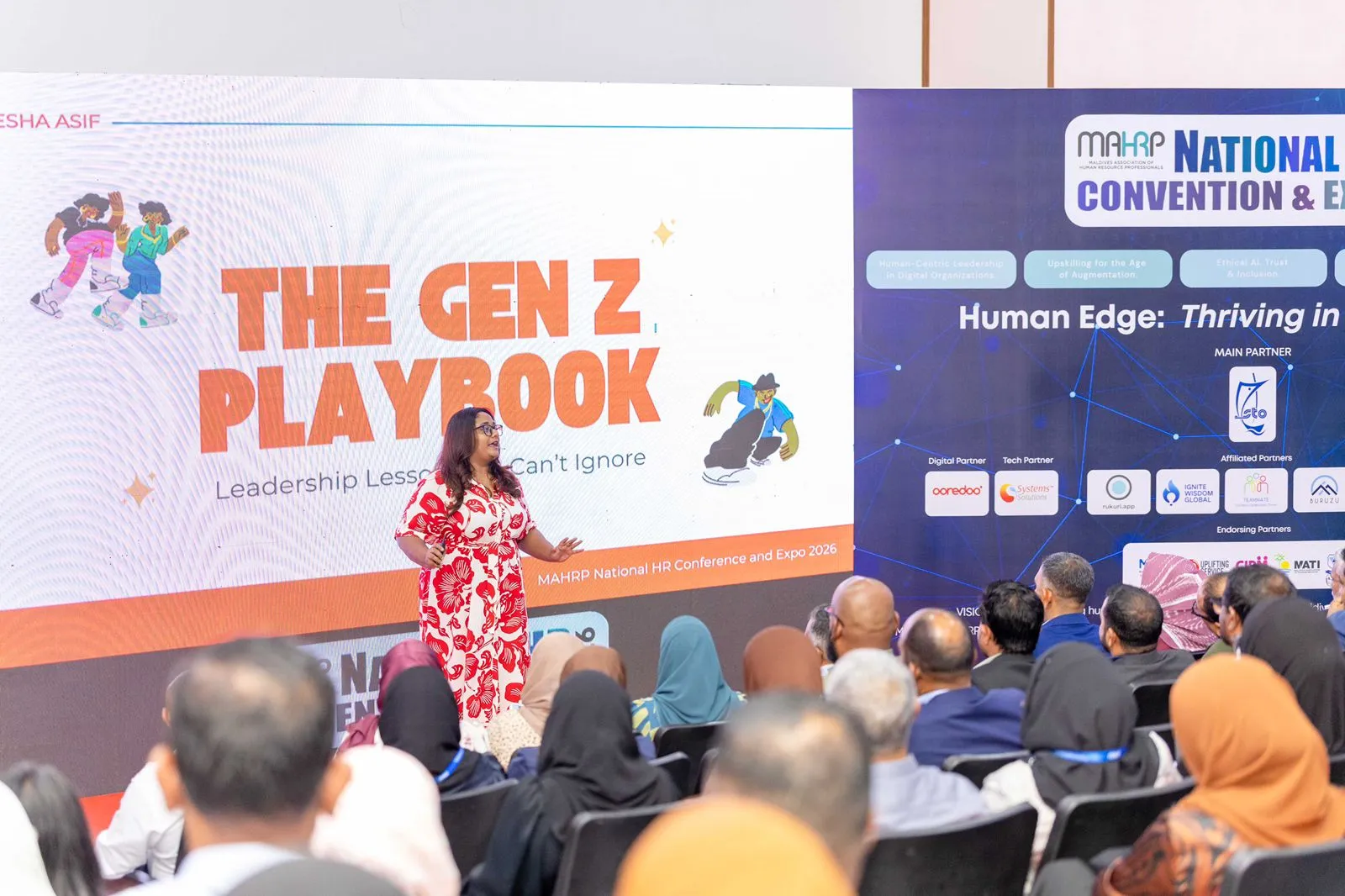
The phrase that summed up a generation
If you had to compress Gen Z's expectations into one sentence, Maeesha told the room, that was the sentence. It circulates casually in conversations between younger workers. She argued it carries a far heavier meaning inside an office.
When a manager assigns a task to a young hire without explaining the reason, the worker may complete it, but will not commit to it. Previous generations learned to tolerate that misalignment. Gen Z does not.
She offered an example that was familiar to thousands of Maldivians in resort work. A housekeeper cleans 12 rooms in a shift. A manager who says, "good job, you cleaned 12 rooms today," is delivering recognition without meaning. A manager who says, "what you accomplished today made 12 guests feel like they are truly home," is connecting one person's work to the brand's purpose.
"Translate company goals into role-level meaning," Maeesha said. "Not everyone understands it on a role level."
In a follow-up interview for this article, Maeesha identified where the gap is widest in the Maldives. Her concern lands on the public sector.
"Not because there is a lack of talented or hardworking people. In fact, there are many passionate individuals within it," she said. The issue, in her view, is institutional speed. "Large institutions often evolve more slowly than the expectations of the modern workforce." She named one quiet assumption she sees often, that "professionalism means silence". The younger workforce, she added, is not rejecting hard work. "They are rejecting work that feels disconnected from meaning or progress."
A generation by the numbers
Gen Z, broadly defined as those born between 1997 and 2012, now makes up around 26 percent of the global workforce, according to McKinsey, with industry trackers projecting the share to rise toward 40 percent by 2030.
The shift is sharper in the Maldives. Youth aged 18 to 35 represent 37 percent of the country's population, according to UN Maldives data drawn from the national census. Tourism, the country's largest private employer, runs on a workforce in which younger Maldivians are increasingly the front line of guest experience.
Maeesha cited findings released on 26 March 2026 to support her argument. 92 percent of Gen Z workers want open discussion about mental health at work. 76 percent rate work-life balance above pay. 75 percent already use AI tools. 86 percent consider a clear sense of purpose important to their employment.
One figure was pointed for managers. 55 percent of recruiters believe Gen Z lack work ethic. Maeesha did not dispute the perception. She challenged its meaning. "Work ethic means different things to different people," she said. "It is not a lack of effort. It is a new way of working."
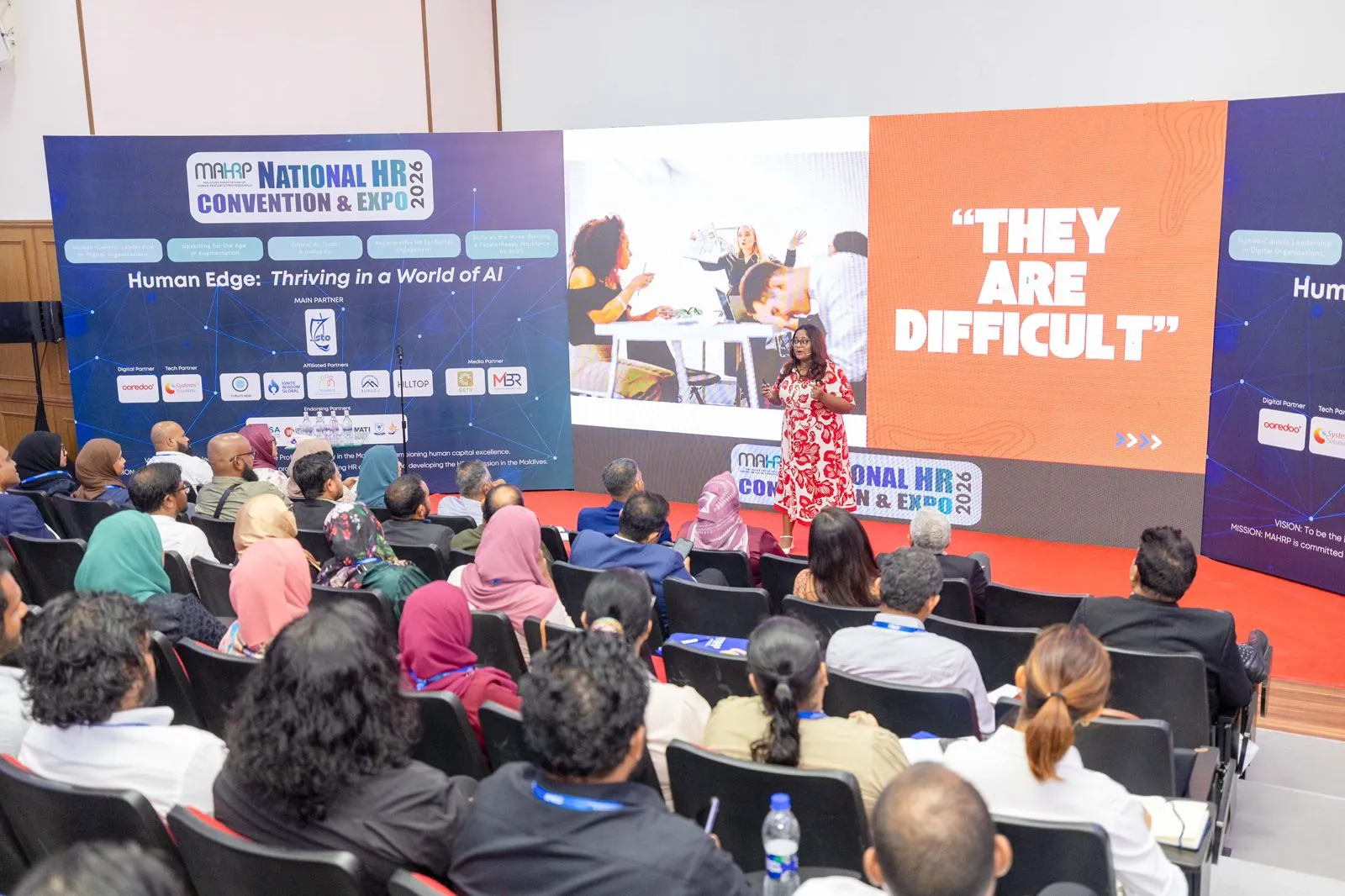
Three myths, one playbook
The keynote was structured around three myths Maeesha said HR leaders most frequently bring to her.
The first was laziness. The reality, she argued, is withdrawal. Gen Z grew up with global visibility into burnout culture, pay gaps and inequality. They ask "why" earlier and louder. Connect every task to a bigger purpose, she said, and stop assuming the company's mission speaks for itself.
The second was job hopping. Industry data supports the premise. Gen Z's average job tenure runs at 1.1 years, compared to 2.8 years for Gen X, according to research compiled by Novoresume. Maeesha's reframing came from inside the data. "They don't leave their jobs," she said. "They leave bad leaders." The prescription was a shift in posture. Replace "did you finish this work?" with "what is getting in your way?" Build mentors, not bosses. She credited Afeef Hussain, the global keynote speaker who closed the same convention, as her own mentor of seven years. Novoresume
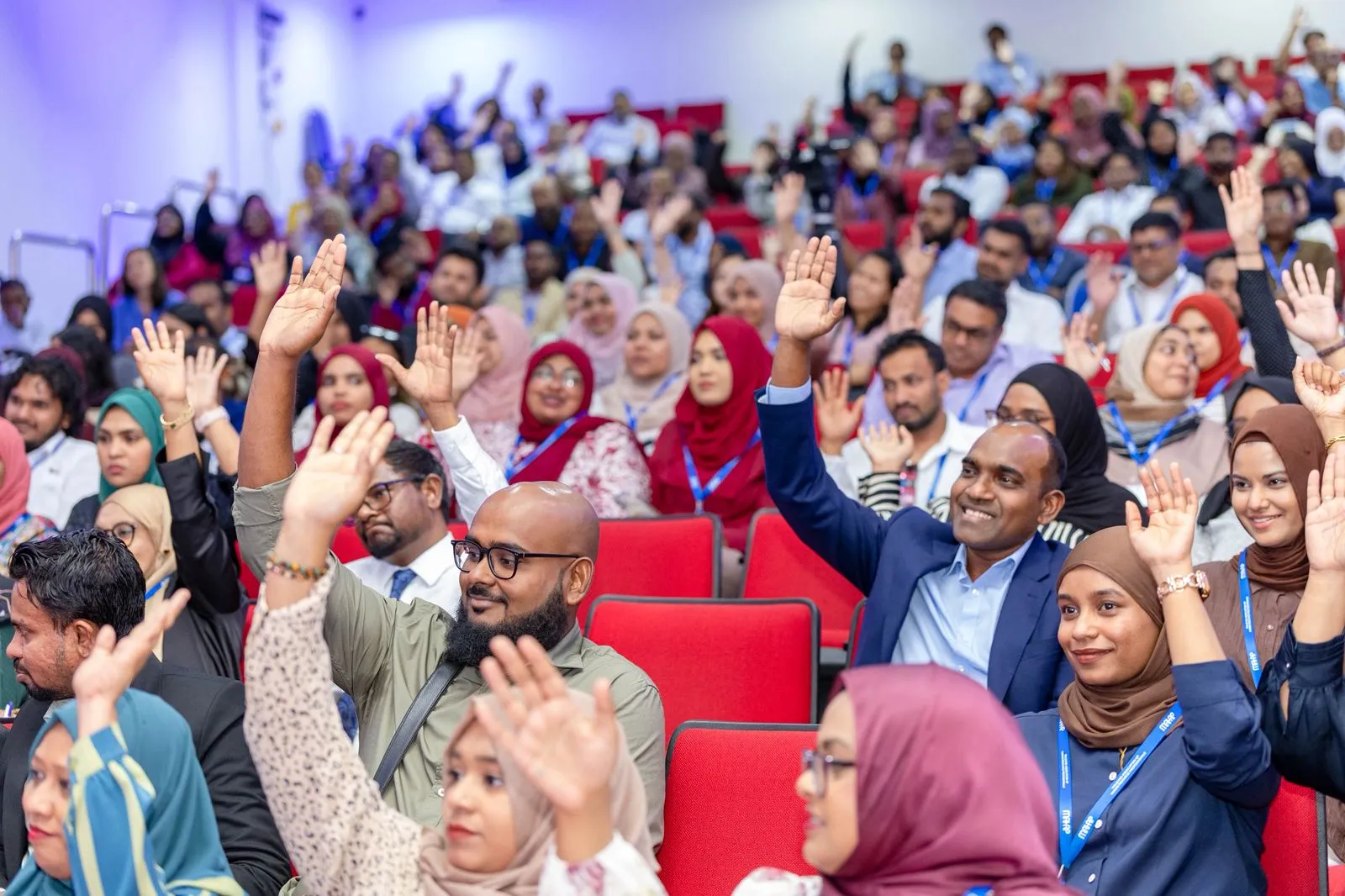
The third was sensitivity. Maeesha told the audience she has been called too sensitive to her face during workplace feedback sessions. She reframed the label as a demand for psychological safety. When she asked the room to raise hands if they had ever held back an idea at work, more than half did. "That's not sensitivity," she said. "That is a signal."
"Focus on the human in human resources," she said.
The upgrade in practice
For organizations still unsure what an empowered Gen Z workforce actually looks like, Maeesha offered a clear Maldivian point of reference.
She has worked on resort projects where teams skewed heavily Gen Z but leadership culture stayed rigid. Ideas were dismissed, she said, "because they challenged existing ways of doing things rather than because they lacked value." Disengagement followed. So did her eventual departure. "It became difficult to thrive in a culture where younger perspectives were constantly viewed as inconvenience instead of contribution."
The contrast is at Crossroads Maldives, where she works now. Across the HR teams of three business units, much of the staff is Gen Z, and the culture has shifted accordingly. "There's room for experimentation, brainstorming, humour, open discussion, and fresh thinking. Meetings are not just about sitting in an office reviewing tasks. Sometimes ideas come from outdoor sessions, interactive activities, team conversations." Fun and professionalism, she added, are not opposites. "People participate more, contribute more ideas, and take greater ownership because they feel like they are building something together rather than simply following instructions."
That, she said, is the upgrade. "It's not about replacing older generations or traditional expertise. It's about combining experience with fresh thinking."
One belief she had to unlearn
Asked what idea about work she has personally had to put down, Maeesha's answer arrived without hedging. "The idea that exhaustion automatically equals success."
She internalized that belief early. Stay up to date, skip breaks, and say yes to everything. Hospitality, she said, normalizes burnout fast. "In many cases, it makes people less present, less creative, less patient, and less emotionally available to their teams."
Her realization came at a personal cost. "Because I normalized burnout for so long, I experienced some of the worst health complications of my life, including developing autoimmune conditions that I am still battling to this day." She still values hard work and discipline. She no longer accepts the trade. "The best workplaces are not the ones where people survive the pressure. They're the ones where people can sustainably thrive within it."
Every people manager in tourism and aviation in the audience knew which line of work that question targeted. As a former head of PR & communications at the country's main international airport, this writer has supervised young teams through exactly the patterns Maeesha described. The work changed when the question changed, learned from senior mentors who had already adjusted. Not "why are they not delivering?" but "what is missing in how I am leading them?"
Maeesha closed her keynote with three questions for the room. Where is progress invisible for young employees on my team? Where do our leaders need help to coach, not just manage? And what is one thing I need personally to unlearn to lead Gen Z better?
The answer the keynote offered, and the interview confirmed, was not a policy document. It was a posture. Honour what has worked. Upgrade what no longer fits.
"Gen Z is not difficult," she told the room one final time. "They are an upgrade to your company."
The full keynote is available at https://www.youtube.com/watch?v=StvDEvFD1sk.
Leave a comment
Comments
No comments yet. Be the first to comment!
Latest News
News
IMF projects Maldives growth to recover to 3.8% in 2027 after weak 2026
13 Oct 2026
News
MIRA collects MVR 2.69 billion in September, 12.7% above forecast
12 Oct 2026
News
BML Earns Global Recognition on Forbes’ World’s Top Performing Banks 2026 List
12 Oct 2026
Ooredoo Maldives
Ooredoo Maldives offers 10 free registration slots for Doha Marathon 2027
12 Oct 2026