

Features
President Lays Out Economic Record and 2028 Targets in Independence Day Address
In his 61st Independence Day address on July 26, 2026, President Dr. Mohamed Muizzu focused heavily on the economy. He said his government inherited an economy "in a pit," paid off a sukuk bond and other loans without printing money, and freed state assets including Dharumavantha Hospital.
26 July 2026, 16:55
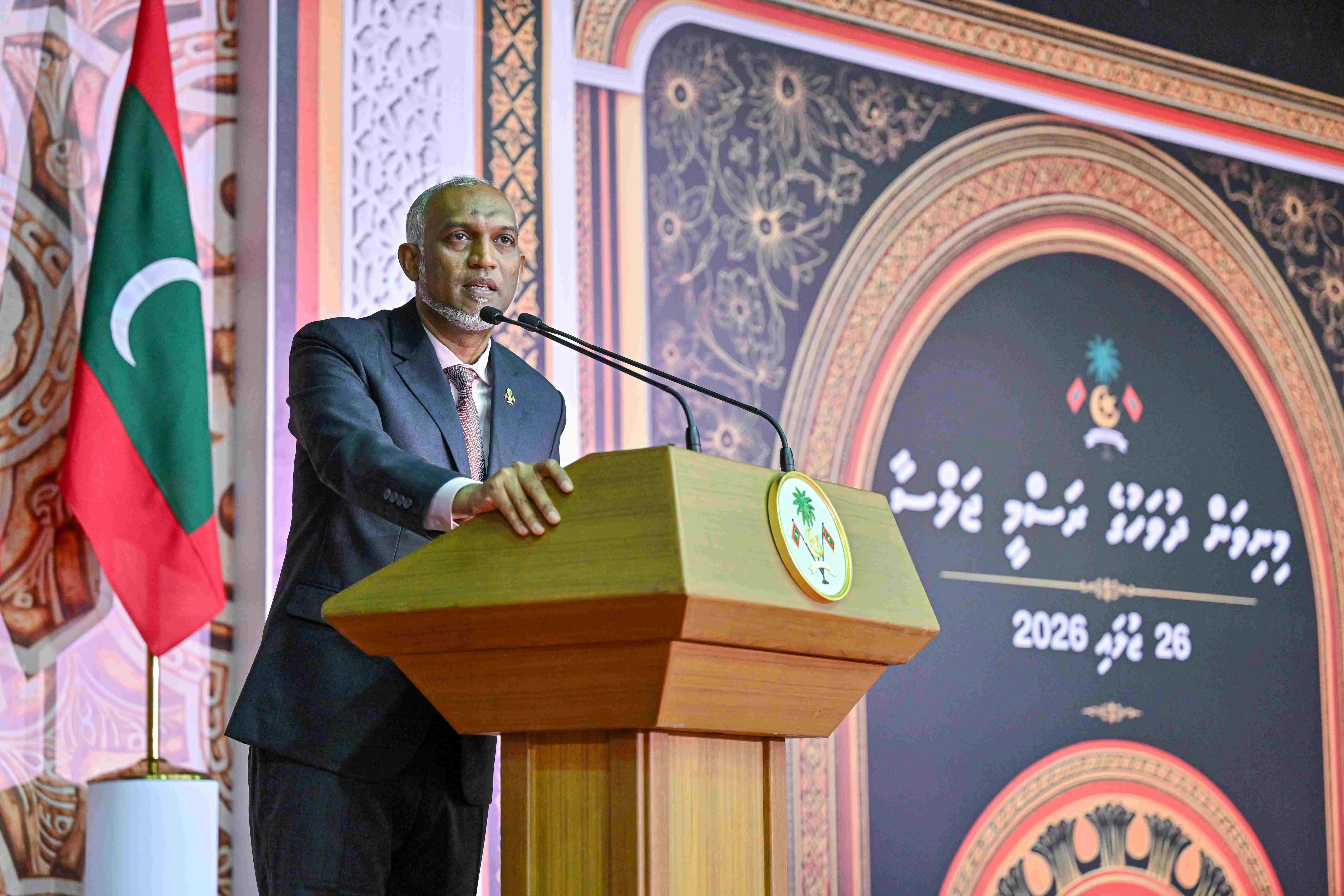
In his address marking the Maldives' 61st Independence Day, President Dr. Mohamed Muizzu devoted a large part of his speech to the economy. He framed economic recovery, debt repayment, infrastructure, and jobs as central to what he called the country's "true independence." This report sets out, in his own terms, what the President said on the economic and business front.
An inherited economy in "a pit"
President Dr. Mohamed Muizzu said the economy was in serious difficulty when his government took office. He said the country's economy was "in a big pit" and its finances were tied down. He said his government has worked to free the economy from that position.
He said his government paid off a sukuk bond and settled numerous other loans. He said state assets, including Dharumavantha Hospital, had been tied up as part of past financial arrangements, and said his government has freed those assets.
Dr. Muizzu also said his government has kept a pledge not to print money to cover government spending. He said that whatever else might be said about his administration, this fact "will remain the fact."
Male's port: one project, one date
Dr. Muizzu named the relocation of Male's Commercial Port to Thilafushi as the single most important project his government is running. He said the port has been stuck in place for years while previous governments talked about moving it without acting.
He said the relocation would be completed by November 11, 2027, when the port would be fully transferred to Thilafushi and opened at a larger scale. He said this would end the congestion currently limiting Male and free up the current port area for other uses.
He said the new port would be entirely owned and controlled by the Maldivian government, with no foreign party holding any share, stake, or role in its operation.
Ending the "medicine mafia"
President Dr. Mohamed Muizzu addressed medicine shortages and prices directly, describing what he called a "medicine mafia" operating in the country. He said certain businesses had been making profits of more than 2,000 percent on some medicines, paid for through the Aasandha health insurance scheme and, by extension, public money.
He said his government introduced a Maximum Retail Price for medicines to stop this. He said the measure would save more than 500 million rufiyaa a year, money he said had previously been lost to what he called "leakage," benefiting a small number of importers.
He said the government has since set up a State Pharma entity to take on this work directly and said he expects the medicine supply issue to be fully and permanently resolved within the next two to three months.
Housing: reclaimed land and rising flats
Dr. Muizzu gave a detailed account of the government's housing program. He said his government inherited flats in Hulhumale that were only 25 percent finished and said the remaining work has since been completed and the flats handed over to residents.
He listed land reclamation projects at Hulhumale Phase 3, Gulhifalhu, and Giraavaru Falhu, saying plots have been issued from each. He described Rasmale as the largest land reclamation project the Maldives has undertaken, intended as a lasting solution to Male's housing shortage.
He acknowledged that work on Rasmale had slowed because of the Middle East war and the resulting rise in fuel costs but said the project restarted this week and that reclamation would be finished within this year. He said this term of government would end with, for the first time in the country's history, a sitting government that had started and physically finished a housing project within its own term.
Tourism, construction, and the Middle East war
President Dr. Mohamed Muizzu said the war in the Middle East had caused the single biggest impact on the tourism industry and also affected construction and other industries. He said the construction sector, in particular, had been on track to close a shortfall of about four percent against what his government had expected before the war began through the efforts of firms working to reclaim delayed ground.
He said his government's approach was to treat the possibility of continued global conflict as a lasting risk and said work is under way with the tourism industry and other sectors to build resilience against future shocks of this kind, including short-, medium-, and long-term measures developed in consultation with industry.
Youth, women, and new industries
Dr. Muizzu spoke about economic empowerment for young people and women as part of what he called the country's social and economic independence. He pointed to a new loan scheme, introduced recently through the Bank of Maldives, offering small loans to young Maldivians, and said more than 5,600 young people have been reached under the scheme so far.
He set a goal for the "creative economy" to contribute at least 15 percent of the country's GDP by 2030, and said this would be pursued alongside vocational education pathways and the National Service program for youth.
He also named fisheries, tourism, agriculture, and construction as the industries his government intends to strengthen further as part of what he called economic independence.
A record measured in projects
President Dr. Mohamed Muizzu said his government has completed 590 development projects in its first two years and eight months in office, compared with 285 completed by the immediately preceding government and 321 by the government before that, over the same length of time.
He said 1,635 projects are currently under way, compared with 414 and 355, respectively, for the two previous administrations over the same period. He said his government would be judged by results rather than promises, repeating the phrase "we will speak through results" more than once in his address.
A list of pledges for 2028
Dr. Muizzu closed his economic remarks with a list of commitments he said would be delivered by July 26, 2028, the next Independence Day but one. Among them: completed water and sewerage systems on every island; a fuel depot supplying STO-rate fuel in every atoll; an airport within 30 minutes of every atoll; expanded health services, including CT scanners, dialysis, and mammography, in every atoll; at least 33 percent of the country's electricity generated from renewable sources; five million trees planted nationwide; and a project promising resort profit-sharing that he said would put "a dollar in every citizen's pocket," which he said should be a fully successful undertaking by 2030.
He also named the Thilamale Bridge, funded through an Indian government loan, and a second phase of Male road works funded by the Chinese government, as projects he expects to see completed within the same period.
Leave a comment
Comments
No comments yet. Be the first to comment!
Latest News
News
Foreign Minister Says Negative Investment Rhetoric Could Strain Diplomatic Ties
15 Oct 2026
News
MACL Prepares Velana Airport for Winter Tourism Peak
15 Oct 2026
News
Singapore Airlines Recognises MACL Ramp Services Team at Velana International Airport
15 Oct 2026
News
Oefaru Seeks Sales Partners Ahead of Vietjet Service Launch
15 Oct 2026