

International
UN Trade Chief Warns of Fragile Global Economy as Geopolitical Risks Displace Trade Disputes
The acting head of UN Trade and Development (UNCTAD), Pedro Manuel Moreno, has called for greater international cooperation as geopolitical risks push the global economy into a more fragile phase. Speaking at the APEC Trade Ministers' Meeting in Suzhou, China, on 22-23 May 2026, Moreno urged support for open regionalism as a stabilizing force.
30 May 2026, 04:14
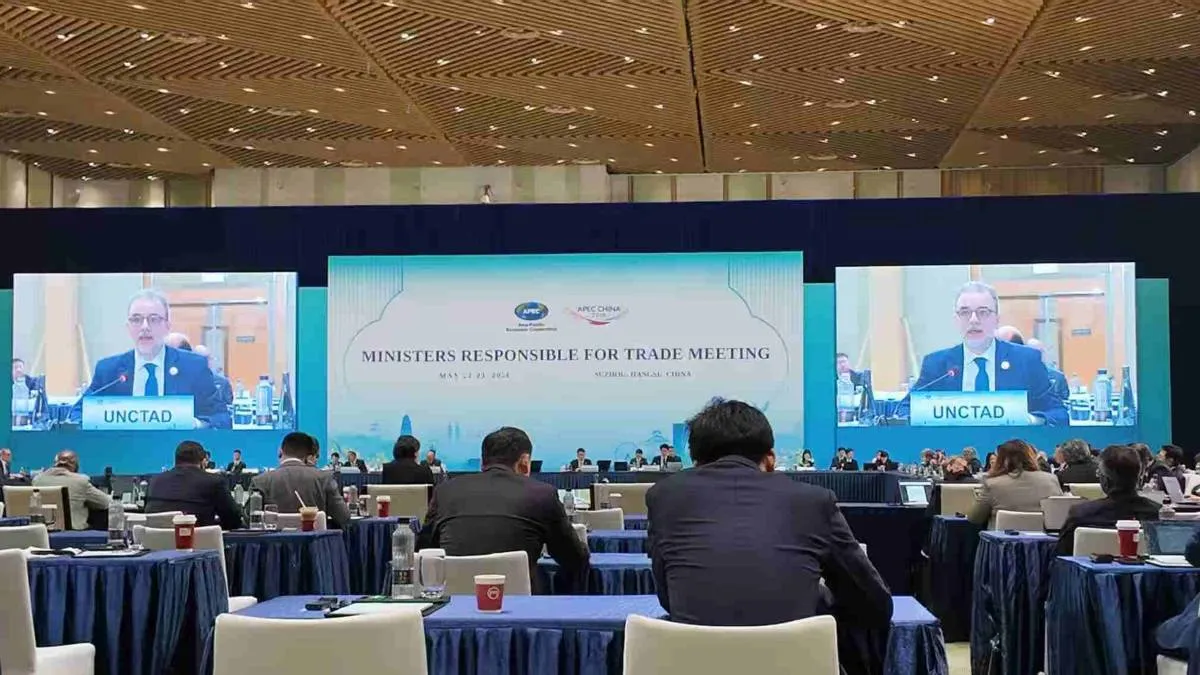
The head of the United Nations trade body has called for renewed international cooperation as mounting geopolitical risks, trade fragmentation, and Middle East conflict disruption push the global economy toward a more vulnerable phase.
Pedro Manuel Moreno, Acting Secretary-General of UN Trade and Development (UNCTAD), made the call at the 32nd Asia-Pacific Economic Cooperation (APEC) Trade Ministers' Meeting in Suzhou, China, on 22-23 May 2026. He told ministers that "open regionalism has been APEC's wager from the beginning" and that, in a world of competing cross-currents, "it remains the right one."
His remarks came as UNCTAD released its flagship Trade and Development Foresights 2026 report. The report warns that the global economy has entered a more fragile phase.
Geopolitical risk overtakes trade disputes
The report states that geopolitical risks have definitively replaced trade policy disputes as the dominant source of instability for the global economy.
UNCTAD projects that global merchandise trade growth will slow sharply, from about 4.7% in 2025 to between 1.5% and 2.5% in 2026. Global economic growth is expected to ease from 2.9% in 2025 to 2.6% in 2026.
The conflict in the Middle East is a key driver. The Strait of Hormuz remains virtually closed. Effects have spread through the global economy within weeks, disrupting energy flows, raising prices, and increasing financial pressure on developing countries.
UNCTAD warns the global economy is moving from an initial phase of supply disruptions and inflation into a "more fragile period, where prolonged uncertainty could trigger shortages and wider financial stress."
AI growth masking deeper weakness
Strong demand for AI-related goods is obscuring weaker momentum across traditional manufacturing and commodity sectors. Global trade growth remained strong into early 2026, with continued expansion in both goods and services, although services growth has slowed in recent quarters. Part of the increase reflects higher prices rather than volumes.
Trade has shown impressive resilience, supported by structural shifts, notably the rapid expansion of services trade, stronger South-South links, and trade related to investments in digitalization and AI. However, shifting rules, financial volatility, and fragmented economic blocs are undermining the confidence needed for sustained investment.
Developing countries face deepest pressure
Higher fuel, food, and fertilizer costs are increasing inflation, financing pressures, and external vulnerabilities for developing economies. UNCTAD also warns that food security is increasingly becoming a financial stability concern.
Around 3.4 billion people live in countries already spending more on debt than on health or education. UNCTAD has consistently flagged that the poorest and most vulnerable economies bear the heaviest costs of global trade disruption.
Earlier in 2025, UNCTAD Secretary-General Rebeca Grynspan called directly for small island developing states and least developed countries to be spared from new tariff measures, warning that what happens to those countries is what "really worries us."
Open regionalism as a stabilizing force
At the APEC ministerial, Moreno pushed for regional cooperation as a practical buffer against global instability. The meeting took place under the chairmanship of China's Minister of Commerce, Wang Wentao, with trade ministers from APEC economies meeting to advance cooperation on strengthening the multilateral trading system and fostering new drivers of trade and investment.
UNCTAD has long argued that open regionalism, meaning regional integration that supports rather than replaces global trade rules, offers a path forward. UNCTAD has called for "open regionalism" as integration that strengthens global links rather than retreating from them, on the basis that "regionalism doesn't replace multilateralism; it complements and reinforces it."
Amid ongoing United States-China trade decoupling, new "connector economies" are emerging, helping sustain global trade flows despite rising fragmentation. For some developing countries, this shift is creating new opportunities to attract investment and integrate into global value chains.
US-China relations: cautious stabilization
The APEC meeting occurred days after the US-China summit in Beijing. US President Donald Trump and Chinese President Xi Jinping used their 14-15 May summit to pledge continued dialogue, with Trump calling the talks "very successful."
Key outcomes included the creation of a permanent US-China Board of Trade, a multi-year agricultural purchase agreement worth at least $17 billion per year, and a commitment from Chinese airlines to purchase 200 Boeing aircraft.
However, independent analysts were more measured. The summit produced no explicit extension of the trade truce and several headline commercial commitments fell short of pre-summit expectations. US Treasury Secretary Scott Bessent later clarified that the US is "not in a rush" to extend the existing trade ceasefire.
What this means for the Maldives
The Maldives is highly exposed to the forces UNCTAD is tracking. As a small island developing state, it depends almost entirely on imported goods. Rising global shipping costs, fuel price shocks, and tightening trade finance all translate directly into higher import bills and inflationary pressure on the local economy.
The tourism sector, which accounts for the majority of government revenue and foreign exchange, is already under strain from Middle East conflict disruption. Further deterioration in global trade conditions could compound pressure on the fiscal position at a time when the Maldives is navigating elevated external debt.
UNCTAD's call for international cooperation and fairer treatment of vulnerable economies is directly relevant to the Maldives' interests. Whether that call will produce concrete policy changes at forums like APEC and the WTO remains to be seen.
Looking ahead
Recent multilateral agreements, including the Sevilla Commitment at the 4th International Conference on Financing for Development, aim to strengthen the global financial safety net and expand access to affordable long-term finance. Whether these commitments translate into action will define the next phase of the global economy.
Strengthening cooperation, reducing fragmentation, and ensuring that developing countries can participate fully in evolving trade patterns will be important for supporting inclusive and sustainable development outcomes. UNCTAD has said that is the real test for the global economy heading into the second half of 2026.
Leave a comment
Comments
No comments yet. Be the first to comment!
Latest News
News
Maldives Expo 2026 adds international exhibitors district
17 Oct 2026
News
Islamic Affairs Ministry targets financial self-sustainability by 2029
17 Oct 2026
News
MWSC tests 500-metre deep seawater in subsea desalination study
17 Oct 2026
MPL
Maldives Ports records busiest quarter with inbound volume reaching 21,182 TEUs
17 Oct 2026