

Features
A Century of Control: Bohra Trade, Political Influence and Economic Power in the Maldives
Carimjee Jafferjee’s Colombo based firm shaped and dominated Maldivian trade and political dynamics for more than a century until government reforms brought Bohra commercial control to an end in 1962.
26 February 2026, 07:45
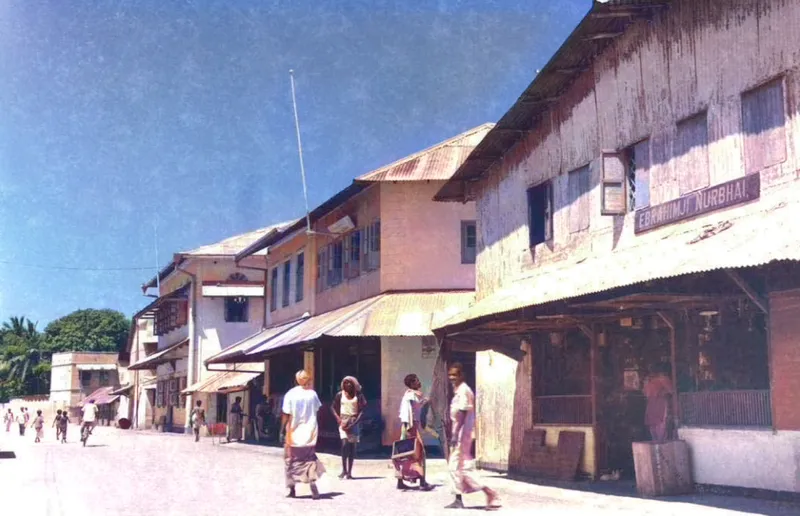
For more than a century, foreign merchant capital shaped the Maldivian economy through control of trade, credit and supply chains. At the centre of that transformation stood the firm of Carimjee Jafferjee, a Colombo based Dawoodi Bohra merchant whose commercial network became deeply embedded in Maldivian political and economic life before being dismantled in 1962 amid rising economic nationalism.
Origins in Kutch and Expansion into Ceylon
Carimjee Jafferjee was born in 1850 in Mandvi, Kutch, into a Dawoodi Bohra trading family. His father, Jafferjee Esajee, first arrived in Galle around 1830 after a storm diverted his vessel during a voyage between Kutch and the Maldives. Instead of resuming the journey, Esajee established a trading base in Ceylon, gradually building a mercantile network through kinship and community ties.

Image: Orabi Pasha (right) with Carimjee Jafferjee (left) and his Son- In- law E.G Adamaly (Image colorized)
By the late nineteenth century, operations had shifted to Colombo, the principal port of British Ceylon. Under Carimjee’s leadership, the firm integrated itself into imperial shipping routes and colonial financial systems, strengthening its regional reach.
Entry into the Maldivian Economy
Before 1857, Bohra and other Gujarati traders conducted seasonal trade in the Maldives, staying temporarily outside the walls of Malé. Permanent settlement began when internal rivalry between the Athireege and Kakaage families prompted Prime Minister Kakaage Mohamed Rannabandeyri Kilegefaan to invite T.I.J. Noorbhai and Company to establish Dhigufihaara in Malé (Abdul Hakeem Hussain Manik, 2000).
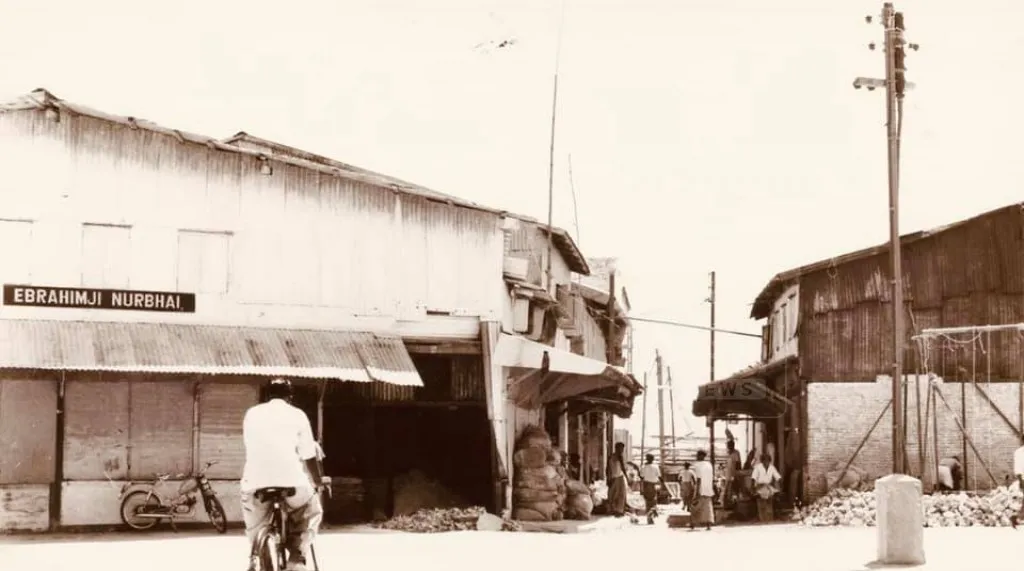
Image: The historic Ebrahimji Nurbhai shop located in Malé.
Subsequent political shifts enabled the well known Ceylonese firm Carimjee Jafferjee to operate in the Maldives. Merchant settlement was thus intertwined with domestic elite competition rather than purely commercial expansion.
From Colombo, Carimjee’s firm exported Ceylon rice to the Maldives and imported dried fish and other Maldivian products. Over time, this evolved into a vertically integrated structure in which Bohra firms controlled both staple imports and export purchasing.
Capital Advantage and Commercial Dominance
The Maldives relied heavily on imported rice while fish exports formed the backbone of its economy. Bohra merchants, with access to shipping fleets and overseas retail networks, possessed capital strength unmatched by most local traders.
According to Historian Naseema Mohamed (2010), only a few Maldivians such as Ali Dhoshimeyna Kilegefaan operated at comparable scale, and even he eventually relocated to Galle. As Bohra shipping networks expanded, Maldivian overseas voyages declined. Mohamed Nasheed (1993) notes that Bohra firms leveraged international markets to retail Maldivian exports competitively, consolidating their dominance.
By 1887, the Maldivian state reportedly owed nearly 100,000 Rufiyaa to the Carimjee Jafferjee company alone (Naseema Mohamed, 2010). This debt strengthened merchant leverage and embedded foreign capital within state finances.
Patronage, Administration and Imperial Protection
Historical accounts suggest that Bohra traders cultivated close relationships with Malé’s elite. The practice known as Thinfilhaara Kekkum involved sending trays of food to influential households, fostering political alignment (Abdul Hakeem Hussain Manik, 2000).
Ibrahim Shafeeq (2012) and Abdullah Imraan (2011) describe allegations of price manipulation, irregular weighing practices and exploitative credit arrangements. Fishermen often faced reduced prices after delivery or payments made in kind rather than cash. Legal disputes reportedly favored the merchants, reinforcing perceptions of administrative compromise.
As British subjects under colonial rule, Bohra merchants could appeal to imperial authorities. Following the Great Fire of Malé in 1887, British officials intervened to address Bohra grievances (Maldives History Committee, 1990). Mohamed Nasheed (1993) argues that British involvement in Maldivian affairs frequently intersected with Bohra commercial interests, reinforcing their position.
War, Strain and Public Discontent
World War II intensified economic tensions. Fish purchase prices reportedly fell from 28 Rufiyaa to 7 Rufiyaa, while rice exchange terms worsened sharply (Ibrahim Shafeeq, 2012). At times, fish purchases ceased altogether, placing heavy strain on fishing communities.
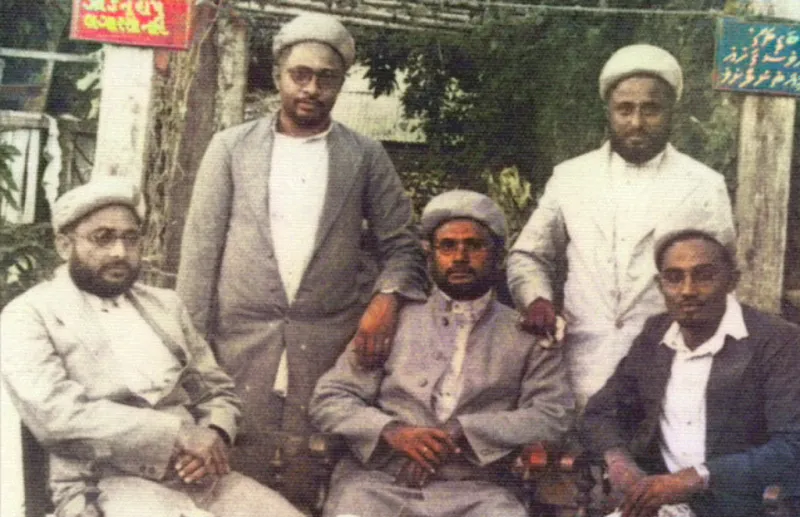
Image: A group of traders from the Bohra community
Allegations of gold and silver smuggling, including the reported case of Nuruddin Dosajee, further damaged public perception (Adam Haleem, 2009). Despite over a century of residence, Bohra capital investment within the Maldives remained limited beyond religious infrastructure such as the Bumbaa Mosque constructed in 1927.
The Rise of Economic Nationalism
Efforts to dismantle commercial monopoly began under Al Ameer Mohamed Amin, who established the Government Bodu Store on December 10, 1942. The state began purchasing fish directly, weakening private control (Ibrahim Shafeeq, 2012).
Political confrontation intensified in 1957 when a bill introduced in the People’s Majlis sought to expel unlicensed foreign traders. Though framed generally, it was widely understood to target Bohra merchants (Mohamed Hamdhoon, 2024). Prime Minister Ibrahim Faamuladheyri Kilegefaan opposed the measure, citing diplomatic risks with Britain and India.
The debate reflected a broader struggle between economic sovereignty and external dependency, with Ibrahim Nasir emerging as a key advocate of reform.
The 1962 Proclamation and the End of Bohra Trade
In 1962, under Prime Minister Ibrahim Nasir, a proclamation restricted Bohra export rights to goods produced by the traders themselves. As they were not domestic producers, this effectively dismantled their trade model.
On August 1, 1962, their right to conduct business was revoked, ending approximately 105 years of dominance (Ibrahim Shatir, 2000; Ahmed Shakir, 2004). A government committee concluded that Bohra traders held no substantial productive capital investment in the country. By that stage, state debts had reportedly been cleared.
The dismantling of Bohra trade preceded the Maldives’ political independence from Britain in 1965, linking economic consolidation to sovereignty.
Legacy in Two Narratives
In Colombo, Carimjee Jafferjee is associated with philanthropy, including the construction of the Karimi Mosque in Pettah in 1905 and support for educational and medical institutions. In Maldivian history, however, his firm represents a period during which foreign merchant capital intersected with elite rivalry, state indebtedness and imperial protection.
The century long Bohra presence illustrates how trade, politics and geopolitics converged in a small island economy. Its rise was facilitated by domestic political competition and structural trade imbalances. Its fall resulted from state intervention, nationalist policy and regulatory enforcement.
Together, these forces reshaped the Maldivian economy and marked a decisive step toward economic independence.
Leave a comment
Comments
No comments yet. Be the first to comment!
Latest News
News
Ras Malé Project Expected to Boost State Revenue with USD 340 Million in Annual TGST
25 Oct 2026
News
Akuru Type Marketplace wins two ICT awards at Maldives Expo 2026
25 Oct 2026
News
Qatar Airways begins three daily Doha–Malé flights
25 Oct 2026
President Muizzu
SMEs to receive overseas USD payments through BML Gateway from November
25 Oct 2026